
⚔️ Greek Mythology Retold ⚔️
MEDUSA: The Priestess Who Became a Monster
The untold tragedy of divine jealousy, mortal innocence, and a curse that destroyed everything. As witnessed and told by Perseus, son of Zeus.
I am Perseus, son of Zeus, ruler of Olympus, and the mortal princess Danaë. From my father, I inherited divine essence. From my mother, mortal blood. I have witnessed many tales where the fates of gods and mortals intertwine in tragic and profound ways.
One such story is that of Medusa—a tale not of monsters and heroes, but of gods wielding their infinite power over those beneath them. This is the truth that Olympus tried to hide. This is the story of how a beautiful, devoted priestess became the most feared creature in all of Greece.
And I, Perseus, am the one who ended her suffering.
Chapter I: The Mortal Among Immortals
Medusa, unlike her sisters, was born mortal—a fact she was blissfully unaware of during her early years. She lived with her family in a small, damp cave near the Aegean Sea, believing herself to be just like her beloved siblings.
Her sisters, Stheno and Euryale, were immortal Gorgons—half woman, half serpent, creatures of terrible power and ancient lineage. But Medusa had smooth porcelain skin and golden hair that shone like the sun itself. Her beauty was both blessing and curse, though she did not yet know it.
Medusa believed her family was like any other. Though loved deeply by her sisters, she felt a subtle distance, a constant reminder of her differences. While Stheno and Euryale possessed scales and fangs, Medusa’s only gift was her radiant appearance—a dangerous gift for a mortal woman in a world ruled by capricious gods.
The Nature of Mortality: In those days, to be mortal among immortals was to be forever separate. Medusa’s sisters loved her fiercely, yet they could not share with her the one thing that defined them—eternity. They knew what she did not: that her beauty would fade, that her life would end, that she was vulnerable in ways they could never be.
One day, while fetching water from a nearby spring, Medusa noticed sailors approaching the shore. Their ship had been battered by storms, and they sought refuge. Curious and eager to explore the world beyond her cave, she decided to approach them, innocent of the danger that mortal men posed.
I am Medusa, from these shores near Athens. Are you lost? Do you need shelter?
By the gods… I have never seen such beautiful golden hair. The sun itself has blessed you, maiden. You shine brighter than any treasure in our hold.
Medusa’s sisters, however, knew all too well the peril that came with strangers—particularly mortal men who looked upon beauty with desire rather than reverence. As the sailors drew closer, their intentions growing clear in their hungry gazes, Stheno and Euryale emerged from the shadows of the cave.
Their monstrous forms caused the men to freeze in terror. Their serpentine lower bodies coiled and uncoiled with menace. Their eyes glowed with an otherworldly power. Within moments, the sailors were turned to stone, their expressions of lust transformed into masks of eternal horror.
Medusa watched in shock, realizing for the first time the terrible power her sisters wielded—and the danger that her very existence invited.
You don’t understand the world as we do, sister. You are mortal, vulnerable. Your beauty draws predators like moths to flame. Only we can protect you from what men would do to claim you.
Chapter II: Dreams of Purpose
Medusa felt increasingly isolated, knowing she would never be like her sisters. She would age while they remained eternal. She would die while they continued on. The weight of her mortality pressed upon her, making her yearn for something more than mere survival in a cave.
Her only true friend was Iphicles, a young warrior in training who dreamed of adventure and glory. He often visited the cave, undeterred by the fearsome reputation of the Gorgon sisters. He saw past the monsters to the lonely girl who craved connection with the outside world.
Medusa cherished their bond, finding in him a kindred spirit who shared her curiosity about the world beyond the Aegean shore.
Iphicles, I know there’s more out there. More than this cave, more than hiding from sailors and living in fear. I want to be part of something greater. I want my life to have meaning.
Then you should visit Athena’s temple, Medusa. It’s a place of wisdom and beauty, just like you. There you would find knowledge, purpose, and a chance to serve a goddess who values strength and intelligence above all else. Athena sees worth beyond mere appearance.
Iphicles’ words ignited a longing in Medusa’s heart. Serving in Athena’s temple felt like a dream—a chance to dedicate herself to something divine, to prove that her life had value beyond her cursed beauty. But it meant leaving her family and the safety of the cave, venturing into a world she barely understood.
Athena, Goddess of Wisdom: Athena was revered as the protector of cities, the patron of heroes, the goddess of strategy and warfare. Her temple in Athens was the most sacred space in all of Greece—a place where mortal and divine could meet, where knowledge was treasured above gold. To serve there was the highest honor a mortal woman could achieve.
After weeks of contemplation, Medusa made her decision. She would go to Athens. She would dedicate herself to Athena. She would transform her cursed beauty into devoted service.
Mother Stheno, beloved sister Euryale, I have made my choice. I shall depart and devote myself to the service of Athena as her priestess. I will make something of this mortal life I’ve been given.
Medusa, the world beyond is harsh and full of dangers we have protected you from. Here, you are safe. Why would you choose to leave? Why would you trust the gods when they care so little for mortals?
Please understand. I long to make a mark upon the world, to serve a higher purpose, to bring about change. I cannot spend eternity hiding in a cave, fearing my own reflection. I must try to be more.
Despite their protests and tears, Medusa’s mind was made up. She embraced her sisters one final time, promising to return when her service was complete, and set out for Athens with Iphicles as her guide and protector.
Chapter III: The Golden Priestess
Medusa arrived at Athena’s temple and dedicated herself fully to the goddess. In the sacred halls, her beauty and devotion quickly made her the center of attention—not just from worshippers, but from priests, nobles, and common people alike.
Crowds gathered not merely for her looks, but for her grace, her intelligence, and her genuine commitment to serving the goddess. She studied philosophy and strategy. She tended the eternal flame. She welcomed pilgrims with warmth and wisdom beyond her years.
Even I, Perseus, when I visited the temple as a young man, saw her and was struck by her deep devotion. She seemed to embody everything Athena represented—beauty combined with wisdom, strength tempered with grace.
But admiration soon turned to something more dangerous: comparison.
Whispers spread through Athens that Medusa’s beauty and dedication rivaled even Athena’s own. Poets composed verses comparing the priestess to the goddess. Artists painted Medusa with a glow that seemed almost divine. The people of Athens began to speak of “Athena’s equal” serving in her own temple.
“The greatest danger for a mortal is not to anger the gods, but to equal them. For the gods are jealous of their glory, and they will tolerate no comparison—not even from those who serve them faithfully.”
— Ancient Greek proverb
Medusa dismissed these whispers as foolish flattery. She had no desire to rival Athena; she only wished to serve her. But the damage was done. The words reached Olympus, and they reached the one god who resented Athena more than any other.
Poseidon, Lord of the Seas.
The Divine Rivalry: Poseidon and Athena had been enemies since the founding of Athens itself. They had competed for patronage of the city—Poseidon offering water from his trident, Athena offering the olive tree. The people chose Athena, and Poseidon never forgave the slight. For centuries, he sought ways to wound his rival’s pride.
When Poseidon heard of the beautiful priestess serving in Athena’s temple—the mortal woman being compared to the goddess herself—he saw the perfect opportunity for revenge. Not against Athena directly, but against what she valued: her temple, her priestess, her pride.
Chapter IV: The God of the Sea
One day, as Medusa walked along the beach near the temple, gathering shells for the altar decorations, the sea grew violent without warning. Waves crashed against the shore with unnatural fury. The sky darkened though it was midday.
From the crashing waves emerged Poseidon himself, towering and terrible, his trident gleaming with power that could shake the very foundations of the earth.
Medusa, your beauty is known even in the depths of the sea. The creatures of the ocean speak of the golden priestess who serves my rival. Come with me, and I will give you treasures beyond your wildest dreams. You will be a queen beneath the waves, immortal and powerful.
No, great Poseidon. I am devoted to Athena. I want nothing from you. Please, leave me in peace.
Athena cannot offer what I can. Imagine the power, the wonders, the eternity I could grant you. You are wasting your mortality serving a goddess who will forget you the moment you die. You deserve the world at your feet, not a broom in your hands.
I will not betray Athena. I beg you, Lord of the Seas, leave me in peace. I have done nothing to warrant your attention.
But Poseidon was not a god to be refused. His desire was not truly for Medusa herself—it was for the opportunity to defile Athena’s sacred space, to prove his power over his rival, to demonstrate that even in her own temple, Athena could not protect what was hers.
He pursued Medusa relentlessly as she ran. Desperate to escape, she fled toward the only place she believed she would be safe: the temple of Athena itself. Surely the goddess would protect her there. Surely divine law would prevent such desecration.
She was wrong.
Medusa burst through the temple doors, gasping for breath, her hair disheveled, her eyes wild with terror. She searched for the goddess, called out for divine protection, but Athena was nowhere in sight. The temple, for all its grandeur and sacred power, was merely stone and marble when the gods chose to look away.
Poseidon entered the temple behind her, his footsteps echoing through the sacred halls. Medusa backed against the altar, trembling, about to surrender to despair.
Then she heard a voice—mortal, desperate, but brave.
Leave her be, Poseidon! She has done nothing to deserve your wrath. She is innocent!
You dare to defy a god, mortal? Step aside or face the consequences of your foolish bravery.
I will not let you harm her. If you want Medusa, you will have to go through me!
Iphicles, armed only with his training sword and his courage, lunged at the god of the sea. With a casual flick of his hand, Poseidon sent a wave of divine energy that hurled Iphicles across the temple. He struck the stone wall with a sickening thud and collapsed, unconscious, his sword clattering to the ground.
Iphicles! Please, you must wake up! Please!
The crash echoed through the temple, breaking its sacred serenity. The noise was enough to draw the attention of the one who should have been watching all along.
Athena, ever vigilant over her domain, descended to investigate the disturbance.
Chapter V: The Curse of Athena
Athena materialized in her temple, her presence filling the space with divine light and power. She saw the unconscious Iphicles, the towering Poseidon, and Medusa—disheveled, terrified, her robes torn from fleeing through the streets.
The goddess did not ask what had happened. She did not investigate the truth. She saw only what appeared to be chaos in her sacred space, and in her divine pride, she made an assumption.
She believed Medusa had invited this desecration. That the beautiful priestess, compared so often to the goddess herself, had brought shame upon the temple through her vanity and lack of devotion.
The Blindness of Gods: This is what mortals fail to understand about the divine—gods do not see as we see. They do not seek truth as we seek truth. Their pride blinds them, their power makes them careless with the lives of those beneath them. Athena saw betrayal where there was only victimhood, because to see otherwise would be to admit she had failed to protect her own priestess.
You have brought shame upon this temple and upon me. Your vanity has led to this desecration. For this, you must be punished.
Please, Athena! I am blameless! Poseidon pursued me. I fled here seeking your protection. I have been faithful. I have served you with all my heart!
Enough! Your beauty has led to this. Your presence has drawn attention to yourself rather than to me. Your choices have led to the defilement of my sacred space. Now you shall face the consequences of your betrayal!
With a wave of her hand, Athena cursed Medusa.
⚡ THE TRANSFORMATION ⚡
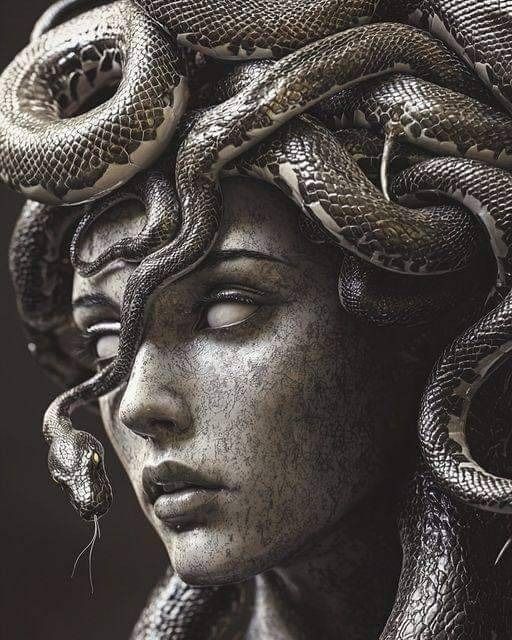
Medusa’s beautiful golden hair, which had shone like the sun, writhed and twisted. Each strand became a venomous serpent, hissing and snapping with newfound life. Her smooth porcelain skin turned to scales, rough and mottled. Her eyes, once warm and kind, became instruments of death—anyone who gazed upon them would turn instantly to stone.
She was no longer a woman. She was no longer mortal. She was something in between—a creature of horror, a monster born not of evil but of divine cruelty.
What have you done to me? All I ever wanted was to serve you, to be close to your heart, to dedicate my mortal life to your glory. Now you’ve turned me into a monster!
You are what you deserve to be. Let this be a lesson to all who would defy the gods through their vanity and pride.
Nearby, Iphicles stirred. The crash that had knocked him unconscious fading as he slowly regained awareness. Hearing Medusa’s anguished voice, he forced himself up, his vision blurry but his heart full of concern.
Medusa… I am here. I will help you. Whatever has happened, we will face it together.
Iphicles, no! Don’t look at me! Please, you can’t! I’m a monster now!
Iphicles, hearing the desperation in her voice, reached his hand out to comfort her, his eyes still adjusting to the light.
I shall not look at you if you wish. But you’re no monster to me. I don’t believe it. No matter what form you take, you are still my friend. You are still Medusa.
As Iphicles stepped closer, guided by her voice, one of the serpents—sensing his movement with predatory instinct—lashed out. Its fangs sank deep into his arm, and he cried out in pain.
Please, keep your eyes closed! I would never think you were a monster, no matter what you look like.
But Iphicles, in his pain and confusion, lifted his head. His eyes searched for Medusa, wanting to see her, to reassure himself that his friend was still there beneath whatever curse had taken hold.
Medusa, let me see you. Let me help—
Their gazes locked for an instant.
Iphicles’ expression was not one of horror, as Medusa had feared. It was not disgust or terror. His face showed only concern, only love for his friend, only the desperate wish to comfort her.
But then his body began to stiffen. His skin turned gray, then white, then hard as marble. The warmth left his eyes, replaced by cold stone. His outstretched hand, reaching toward her in friendship, froze forever in that gesture of compassion.
Medusa… I’m sorry… I should have protected you better…
His body completed its transformation. The only friend she’d ever had, the boy who had shown her the path to the temple, who had defended her against a god, now stood as a statue—a monument to loyalty and tragic fate.
No… no, please. Iphicles, come back. Please don’t leave me. I’m sorry. I’m so sorry!
Medusa knelt beside the stone form of her friend, her heart shattered. The serpents on her head hissed softly, as if sharing her grief. Overwhelmed by sorrow and horror at what she had become, she fled the temple, desperate to escape the nightmare that her devotion had created.
Chapter VI: The Monster’s Isolation
Medusa found a remote cave far from civilization—darker and more isolated than the one she’d grown up in. There, she wept for days, haunted by the loss of Iphicles and the memory of his final look of compassion frozen in stone.
But even in isolation, there was no peace.
Word of the cursed Gorgon spread throughout Greece. Poets told tales of the monster in the cave, the creature whose gaze turned men to stone. They omitted the part about the innocent priestess. They forgot to mention Poseidon’s assault or Athena’s unjust punishment.
In their stories, Medusa was simply evil—a monster to be feared and hunted.
Warriors came seeking glory. Some wanted to prove their courage. Others sought the monster’s head as a trophy. Each one who found her cave met the same fate: stone.
Medusa was forced to defend herself, and with each life she took—even in self-defense—her heart broke a little more. The cave entrance became a garden of statues, warriors frozen in their final moments of aggression or terror.
“The cruelest punishment is not death, but living as the thing you never wanted to become. Medusa did not choose to be a monster. She was made into one by gods who punished her for being a victim. And then she was forced to become what they claimed she always was.”
Years passed. Medusa’s sisters found her and stayed with her for a time, but even their presence could not ease her loneliness. They were still immortal Gorgons, unchanged. She was now something else—cursed, hated, hunted.
She lived in the darkness, emerging only when necessary, speaking to no one, hoping for nothing but an end to her cursed existence.
Chapter VII: The Hero’s Quest
As the years passed, I became the warrior I had always aspired to be, mindful of my father Zeus’s legacy and my destiny to achieve great things. Tales of Medusa’s grim fate—a once gentle soul twisted into a fearsome creature—reached me through the stories told by bards and warriors.
I didn’t want to believe them. The few details I’d heard of her past suggested tragedy, not evil. But the stories persisted, and eventually, they reached Olympus itself.
One night, the gods summoned me through a vision. Athena appeared in my dreams, radiant and terrible, commanding me with divine authority.
Perseus, son of Zeus, you are favored among men by the gods. I have a task for you—one that will test your courage and loyalty to Olympus. You must slay the monster Medusa and bring me her head. Only then will you truly prove yourself worthy of your divine heritage.
The very thought was unbearable. To kill a creature who had once been an innocent priestess? To complete a task born of divine jealousy and cruelty?
But I knew I had no choice. The gods had decreed it, and to refuse would be to invite their wrath upon myself and those I loved. The fate of my mother, my future, everything I held dear—all depended on my obedience.
Great Athena, the task seems impossible. If my eyes set upon her, I will be turned to stone like all the warriors before me. How can I succeed where so many have failed?
In the dream, Athena handed me a shield—polished to a mirror-like gleam, capable of reflecting perfectly without distortion. When I woke, the shield was in my hands, proof that the gods’ command was real.
The Irony of Divine Gifts: Athena gave me the means to kill Medusa, but she did not tell me the truth of what had happened in her temple. She armed me to slay the victim of her own cruelty, making me an instrument of her continued vengeance. The gods use heroes as tools, never revealing the full story, never admitting their own guilt.
I soon set out for Medusa’s cave, my heart heavy with the knowledge of what I must do. The journey took weeks, passing through lands made desolate by fear of the Gorgon. Villagers warned me to turn back. Fellow warriors showed me their friends who had been turned to stone.
But I pressed on, guided by divine mandate and the weight of destiny.
Chapter VIII: The Final Encounter
When I entered the cave, the darkness was absolute. The air smelled of brine and sorrow. Statues lined the walls—warriors frozen in time, their expressions ranging from rage to terror to pity.
I heard a rustle, a hiss of serpents, and then her voice—soft, sorrowful, and filled with a pain that cut me to the core.
Leave this place, stranger. Please. I do not wish to harm you. I have harmed too many already. Turn back while you still can.
Medusa, it is I, Perseus, son of Zeus. I have come… I have come to end your misery. Athena herself has sent me. I am sorry.
At the mention of Athena, a profound sorrow gripped Medusa’s heart. The weight of her transformation—from beautiful priestess to horrific monster—filled her with shame. Tears welled in her eyes, tears that no one had seen since the day of her curse.
Athena… Of course it would be her. The goddess who cursed me for being assaulted in her temple now sends a hero to finish what she started. Tell me, Perseus, does she speak of what really happened? Or does she call me a monster who deserved this fate?
She… she did not tell me your story. Only that you must be slain.
Then let me tell you the truth before I die. I was her priestess. I served her faithfully. I was devoted. And when Poseidon pursued me, when I fled to her temple for protection, she was not there. He desecrated her sacred space, and she punished me—not him, but me—for daring to be beautiful, for daring to be compared to her.
I stood in that darkness, holding the mirrored shield, listening to her words, and understanding for the first time the true nature of the gods’ cruelty.
Then I am sorry. Truly sorry. But I cannot refuse the gods’ command. My mother’s life, my future—all hang in the balance.
I understand. I do not blame you, Perseus. You are as much a pawn of the gods as I am. Perhaps… perhaps death will finally free me from this curse. Perhaps I will finally find peace.
She accepted the inevitable, knowing that this was the only way to end her torment and escape the endless suffering that had consumed her cursed life. In that moment, I saw not a monster, but a soul desperate for release.
Through the reflection in my shield, I saw her one final time. The once-beautiful Medusa was now a tormented creature. Her radiant face had become gaunt and scaled. Her golden hair had been replaced with serpents that writhed endlessly. But her eyes—those cursed eyes that turned men to stone—still held the remnants of the innocent priestess she had once been.
She looked at me through the reflection and whispered, “Thank you for ending this.”
With a heavy heart, I raised my sword and struck.
⚔️ THE DEATH OF MEDUSA ⚔️
Her blood spilled upon the cave floor, and from it emerged two beings: Chrysaor, a golden warrior born from her suffering, and Pegasus, the winged horse born from her dreams of freedom. Even in death, Medusa’s curse gave birth to new life—beauty emerging from tragedy.
I took her head as Athena had commanded and left the cave. The serpents on her severed head still writhed, the curse still active even after death. Her eyes could still turn living beings to stone, making her useful to the gods even in death.
But the victory felt hollow. The triumph was meaningless.
I had not slain a monster. I had killed a victim.
Chapter IX: The Final Cruelty
I brought Medusa’s head to Athena on Olympus, as commanded. The goddess took it without a word of thanks, without acknowledgment of the tragedy she had created. She examined it with cold satisfaction, pleased to have the tool of her revenge finally complete.
Then, with divine power, she placed the severed head upon her aegis—her shield of war.
Medusa’s head would remain there for eternity, her cursed eyes still potent, her serpents still writhing. She would become a symbol of Athena’s power, a warning to all who would challenge the goddess of wisdom.
Hail the goddess of wisdom! Hail Athena! See how she wields even the monsters of the world! None can stand against her power!
The people of Athens praised Athena for conquering the terrible Gorgon. They did not know the truth. They did not know that Medusa had once served in their very temple, that she had been one of their most devoted priestesses.
The irony was devastating.
⚡ THE ULTIMATE IRONY ⚡
Out of the tragedy, in a cruel twist of fate, Medusa did get the one thing she always wanted: to be close to Athena’s heart once again.
She who had been cursed for serving too faithfully, who had been punished for being too beautiful, who had been transformed from priestess to monster—she now resided upon Athena’s shield, closer to the goddess than any living priestess could ever be.
But she was dead. And her closeness to Athena’s heart was not love, but possession. Not honor, but trophy. Not redemption, but eternal punishment.
Epilogue: The Truth That Olympus Hides
I am Perseus, and I tell you this story not to glorify my deed, but to speak the truth that the gods wish buried beneath their legends.
In the end, Medusa’s story is not only tragic but profoundly ironic. Athena’s jealousy and vengeance against a mere mortal ultimately made Medusa’s name unforgettable. Once a victim of divine wrath, her legacy is now immortalized in the very mythology that sought to destroy her.
The gods tell stories where they are heroes and mortals are monsters. But I have seen the truth: sometimes the gods are the monsters, and the mortals are merely victims of divine cruelty.
Medusa was never evil. She was beautiful, devoted, innocent. Her only crimes were being born mortal in a world ruled by jealous gods, and being cursed with beauty that drew the wrong kind of attention.
Poseidon faced no punishment for violating her. Athena faced no consequences for her unjust curse. Only Medusa suffered—transformed, isolated, hunted, and finally killed.
And yet, her story endures. Thousands of years later, people still speak the name Medusa. They remember the priestess who became a monster, the victim who was blamed for her own assault, the cursed woman who died seeking nothing but peace.
The gods wanted her forgotten. They wanted her to be nothing more than a monster in a hero’s tale.
Instead, she became immortal in memory—more lasting than any temple, more powerful than any curse.
That is Medusa’s true victory over the gods who destroyed her.
The Legacy of Medusa
In the tapestry of Greek mythology, Medusa’s story stands as a reminder that the monsters we fear are often victims we failed to protect. Her name endures not as a warning against evil, but as a testament to the injustice that can be inflicted upon the innocent by those with power.
She was not born a monster.
She was made into one by gods who punished her for being victimized.
May her story never be forgotten. May her truth finally be told.