
GREEK MYTHOLOGY
When Love Defied Death: The Tragic Tale of Orpheus and Eurydice
In ancient Greece, one man’s love was so powerful that he dared to enter the realm of the dead. This is the story of the greatest musician who ever lived, and the choice that doomed him forever.
The Wedding Day
The sun had never shone brighter over the hills of Thrace than it did on the day Orpheus married Eurydice.
Garlands of wildflowers draped every tree, and the air hummed with celebration. Gods and mortals alike had gathered to witness the union, for this was no ordinary wedding. The groom was Orpheus, son of the Muse Calliope—a man whose music could make rivers change their course, trees uproot themselves to dance, and the wildest beasts lie down in peace.
But it wasn’t his divine heritage that made this day remarkable. It was the way he looked at his bride.
Eurydice moved through the crowd like sunlight through leaves, her laughter bright as birdsong. She was a wood nymph, born of the forest itself, with eyes the color of moss after rain and hair that cascaded down her back in waves of chestnut and gold. When she smiled at Orpheus, the entire world seemed to fade away, leaving only the two of them suspended in a moment of perfect joy.
“I never believed in fate until I met you.”
Eurydice’s fingers intertwined with his. “Then we’ll make our own fate. Together.”
The guests raised their cups. The music swelled. And for one perfect, shining moment, it seemed as though nothing could ever go wrong.
Then Eurydice stumbled.
It happened so quickly that at first, no one understood. She had been dancing across the meadow, her bare feet light on the grass, when suddenly she gasped and fell. The music stopped. The laughter died.
Orpheus reached her in seconds, dropping to his knees beside her prone form. Her skin had already gone pale. Her breath came in shallow gasps. She tried to speak, but no words came—only a small, desperate sound that broke Orpheus’s heart into a thousand pieces.
That’s when he saw it: two small puncture wounds on her ankle, already darkening with venom. And slithering away through the tall grass, almost invisible in the shadows, a serpent disappeared into the underbrush.
The poison was already racing through her veins. Eurydice’s eyes, those beautiful moss-green eyes, found his one last time. Her lips formed his name, though no sound emerged. Then the light within them flickered and went out, like a candle extinguished by an unseen hand.
She was gone.
The wedding guests stood frozen in horror. The gods themselves seemed to hold their breath. And Orpheus, the man whose music had charmed the entire world, opened his mouth and screamed.
The Mourning
They burned Eurydice’s body on a pyre overlooking the sea, as was customary. They sang the funeral hymns and spoke words of comfort that meant nothing. They watched as the smoke carried her spirit away toward the distant gray shores of the underworld.
And through it all, Orpheus said nothing.
He did not eat. He did not sleep. He sat beside the smoldering ashes of the pyre for three days and three nights, his lyre lying forgotten beside him. Friends came and went, offering condolences, but he didn’t seem to hear them. His mother, the Muse Calliope, wept for him, but even her divine tears could not reach the darkness that had swallowed her son.
On the fourth day, as dawn broke over the mountains, Orpheus finally stood.
He picked up his lyre, and for the first time since Eurydice’s death, he began to play.
The melody that poured forth was like nothing anyone had ever heard. It was grief made manifest—so raw and beautiful and terrible that those who heard it felt their hearts might shatter. Birds fell silent. The wind itself seemed to pause. Even the waves stopped crashing against the shore, as if the sea were listening.
But Orpheus wasn’t playing for them.
He was playing for her. For Eurydice, wherever she was. And as he played, a decision crystallized in his mind with absolute clarity.
He would go to the underworld and bring her back.
His friends tried to stop him. “No living soul has ever returned from that place. The gates are guarded by monsters. The rivers are impassable. The gods of death show no mercy.”
“Then I’ll be the first,” Orpheus replied.
His mother begged him to reconsider. “My son, I know your pain. But what you’re planning is madness. Even the gods fear to trespass in Hades’s realm.”
Orpheus met her eyes, and she saw something in them that made her fall silent—a determination so fierce it bordered on obsession.
“I don’t care if I have to challenge Death itself. I will not live in a world without her.”
And so, as the sun set on the fourth day of his mourning, Orpheus began his journey to the land of the dead.
The Descent
The entrance to the underworld lay hidden in a cave at the base of Mount Taenarum, where shadows pooled like black water and no bird sang. The mouth of the cave yawned before Orpheus like a wound in the earth, exhaling cold air that smelled of stone and endings.
He did not hesitate.
The passage descended steeply, the light from the surface fading with each step until darkness enveloped him completely. But Orpheus walked on, his lyre clutched to his chest, Eurydice’s name a prayer on his lips.
After what felt like hours—or perhaps days; time moved strangely in that place—he heard it: a low, rumbling growl that seemed to come from everywhere and nowhere at once.
Cerberus.
The three-headed hound of hell emerged from the shadows, each head larger than a bear, fangs like daggers gleaming in the dim phosphorescent glow of the cavern. The beast’s six eyes fixed on Orpheus with hungry intelligence, and all three mouths began to snarl.
Any sane person would have run. Would have screamed.
Orpheus began to play.
The first notes trembled in the air, tentative and soft. Then they grew stronger, weaving together into a melody so achingly beautiful that even the guardian of the dead paused. Orpheus played of green meadows and warm sunshine, of fresh meat and gentle hands, of a time before this creature had been chained to darkness. He played the song of a dog who had once been loved.
Slowly, incredibly, Cerberus’s three heads lowered to the ground. A rumbling sound emerged from the beast’s chest—not a growl, but something almost like a purr. By the time Orpheus walked past, all six eyes had closed, and the monstrous hound slept as peacefully as a puppy.
The tunnel opened onto the banks of a vast underground river. The River Styx, boundary between the living world and the realm of the dead. Its waters ran black and thick, like oil, and the air above it shimmered with the weight of a million sorrows.
At a rickety dock, a figure stood waiting.
Charon the ferryman was impossibly ancient, his face more skull than flesh, his robes hanging from his skeletal frame like grave shrouds. He poled a barge made of bones and rotting wood, and his empty eye sockets somehow still managed to convey contempt as Orpheus approached.
“The living are not permitted here. Turn back.”
“I must cross. Please.”
“The price is one obol, placed beneath the tongue of the dead. You have no payment. You have no right. You have no—”
Orpheus raised his lyre and began to play.
This time, he played of endings and farewells, of loved ones lost and the unbearable weight of continuing on alone. He played of Charon’s eternal duty, ferrying the dead across dark waters for all eternity, never resting, never relieved, never thanked. He played what it meant to be forgotten by the living and feared by the dead, to serve without recognition, to labor without hope.
A sound emerged from Charon that might have been a sob, had the ferryman possessed lungs to draw breath.
“Cross. Cross, and let me hear no more. Your music breaks what cannot be broken.”
The Court of the Dead
The palace of Hades rose from the gray landscape like a monument to despair. Built from black marble veined with silver, it towered over the Fields of Asphodel where the shades of ordinary souls wandered in endless twilight, remembering nothing, feeling nothing, being nothing.
Orpheus walked through halls lined with the treasures of the dead—golden crowns worn by forgotten kings, jewelry that had adorned long-rotted corpses, weapons that had won wars no one remembered. The air was cold and still, and his footsteps echoed like a heartbeat in the silence.
Finally, he came to the throne room.
Hades sat upon a throne of obsidian, a crown of shadows resting on his dark brow. He was beautiful in the way a storm is beautiful—terrible and absolute and utterly without mercy. Beside him, on a throne of her own, sat Persephone, Queen of the Dead. She wore a crown of pomegranate blossoms, and her eyes held both the warmth of spring and the cold finality of winter.
Around them, the court of the dead stood witness. Tantalus, forever reaching for water he could never drink. Sisyphus, his boulder momentarily still at the base of his endless hill. The Furies, their serpent hair writhing, their eyes burning with eternal rage.
All of them turned to stare at the living man who had dared to enter their domain.
“Orpheus, son of Calliope. You trespass in my kingdom. Give me one reason why I should not add your shade to my collection.”
Orpheus knelt, not in submission but in respect. Then he stood, raised his lyre, and began to sing.
He sang of Eurydice.
He sang of the first time he saw her, dancing in a forest glade, and how his heart had recognized something it didn’t know it was searching for. He sang of her laughter, which sounded like water over stones. Of her kindness, which extended to every creature, no matter how small. Of the way she said his name, turning it into something sacred.
He sang of their wedding day, of joy so pure it hurt. Of the moment that joy turned to ash. Of holding her as the light left her eyes, and knowing that half of his soul had been ripped away.
He sang of a love so deep that death itself seemed like a minor obstacle, a door that could surely be opened if only he knocked loud enough.
“Great Hades, merciful Persephone, I know that Eurydice’s soul belongs to you now. I know that all living things must eventually dwell in your kingdom, that this is the natural order of existence. But she was taken too soon. We had only hours together as husband and wife, when we should have had years. Decades.”
He met Hades’s terrible gaze without flinching. “The day will come when I, too, cross the River Styx. When I stand before you as one of the dead, not as a living supplicant. On that day, Eurydice and I will have eternity together in your realm. But until then, please—I beg you—grant us the years we should have had.”
The final note hung in the air like a prayer.
Silence.
The court of the dead stood frozen. Tantalus had stopped mid-gesture, his arm still extended toward his water. Sisyphus had abandoned his boulder entirely, staring at Orpheus with something like wonder dawning in his dead eyes. The Furies—the Furies who had never shown mercy, who existed only to punish and torment—were weeping, black tears streaming down their terrible faces.
Even the shadows seemed to lean in, listening.
Persephone’s hand found her husband’s. She leaned close and whispered something in his ear. Hades’s expression remained unreadable, but something flickered in the depths of his dark eyes.
Finally, he spoke.
“Your music has moved even the stones of my palace, Orpheus. Your love has made the Furies weep, which I did not think possible. I will grant your request. Eurydice may return with you to the world of the living.”
Hope—brilliant, overwhelming, impossible hope—flooded through Orpheus.
“On one condition.”
The hope flickered, but held.
“You will climb back through the underworld and return to the land of the living. Eurydice’s shade will follow behind you. But you must not turn around to look at her. Not once. Not until you both stand fully in the light of the sun. If you turn around even once before you have completely left my realm, she will return to the land of the dead forever. Do you accept these terms?”
It seemed too easy. Too simple. Just walk, and don’t look back. Of course he could do that.
“I accept.”
The Climb
Orpheus began to walk.
The same path he had descended now stretched before him, leading up and up toward the distant world of light and life. His footsteps echoed in the cavernous passages, marking time, measuring distance.
Behind him, he heard nothing.
At first, this didn’t trouble him. The dead made no sound, after all. Their feet didn’t disturb dust. Their breath didn’t fog the air. He knew this. He reminded himself of this with every step.
But as he climbed higher, doubt began to creep in.
What if Hades had tricked him? What if this was all some cruel joke, and there was nothing behind him but empty air and his own desperate hope?
No, he told himself firmly. Hades gave his word. The gods may be cruel, but they don’t break oaths.
He focused on walking, on the sound of his own breathing, on the growing warmth in the air that suggested he was getting closer to the surface. One step. Another. Another.
But the silence behind him was maddening.
He passed Charon’s dock. The ferryman was there, motionless as a statue, watching him with those empty eye sockets. Orpheus wanted to ask—Is she there? Is she following me?—but he didn’t dare speak. Didn’t dare break his concentration.
He kept walking.
The passage grew steeper. His legs began to ache. How long had he been climbing? Hours? Days? Time felt slippery here, unreliable.
And still, he heard nothing behind him.
What if she fell? The thought struck him like a blow. What if she stumbled, and she’s lying hurt somewhere in the darkness, and I just keep walking, leaving her behind?
No, no, that was ridiculous. She was a shade now. The dead didn’t stumble. They didn’t hurt.
But what if?
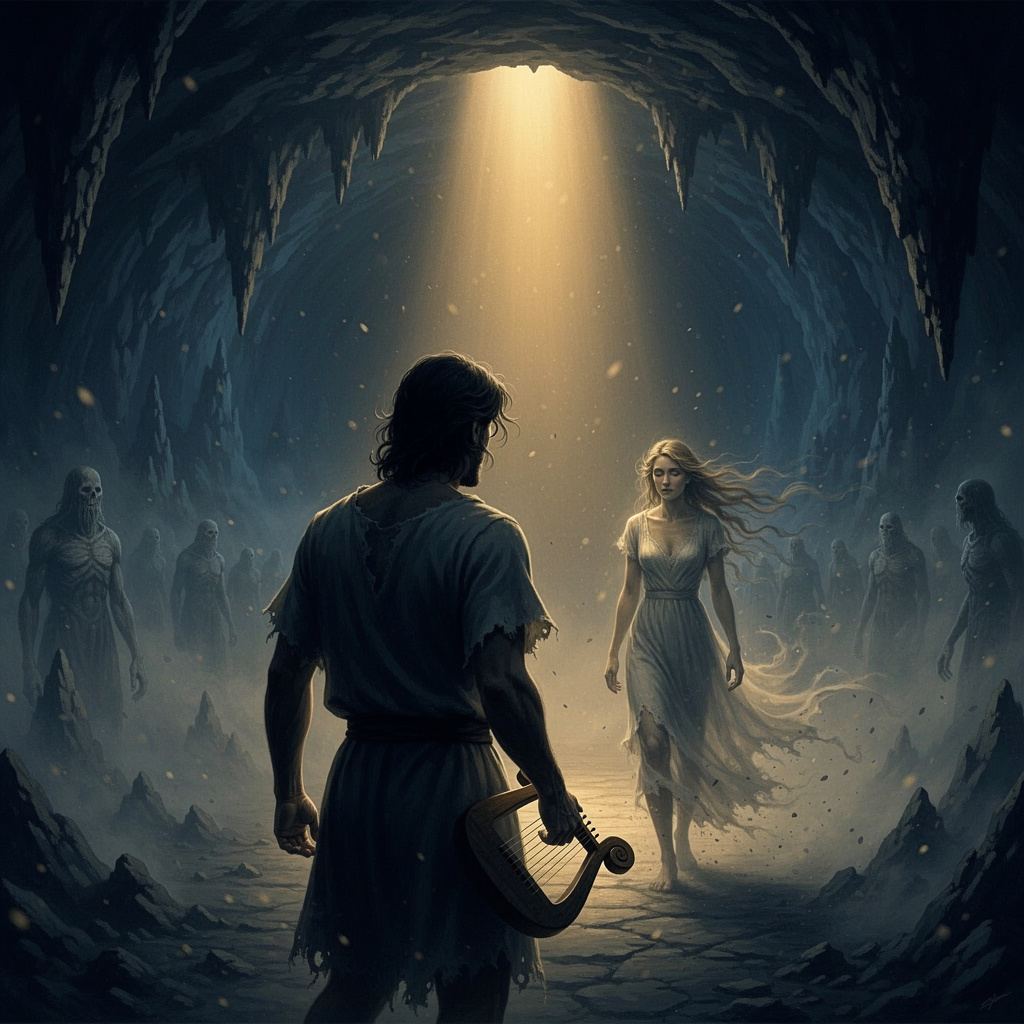
The tunnel began to brighten. Somewhere ahead, impossibly far but definitely there, he could see it—a point of light. The exit. The surface. The world of the living.
Hope surged through him, strong enough to make his eyes sting with tears. They were going to make it. He was going to save her.
His pace quickened.
The light grew brighter, closer. He could feel warmth on his face now, real warmth. He could smell growing things, living things. Earth and grass and flowers.
Almost there. Almost home.
But in his excitement, a new fear bloomed. What if Eurydice couldn’t see the light? What if she was still stumbling through darkness, lost and afraid? What if she needed him to slow down, to wait for her, to turn around and guide her?
The light was so close now. Ten more steps. Nine. Eight.
I have to know, he thought desperately. I have to be sure.
Seven steps. Six.
Please let her be there. Please, please, please.
Five steps.
I can’t lose her again.
Four steps. Three. Two.
One.
Orpheus stood at the threshold between darkness and light, one foot still in shadow, one about to step into the sun.
I have to see her face.
He turned around.
The Price
For one heartbeat, one perfect crystalline moment, Orpheus saw her.
Eurydice stood in the shadows behind him, just barely visible in the dim light. She looked exactly as she had on their wedding day—beautiful, alive, real. Her eyes met his, and he saw recognition there, and love, and—
Horror.
“No. Oh, Orpheus, no—”
Her form began to waver like smoke in wind. The substance of her seemed to thin, to fade, pulled back by invisible hands toward the darkness.
“Eurydice!” Orpheus lunged forward, reaching for her, but his hands passed through empty air.
She was already gone, already falling back into the underworld, her shade being dragged down and down and down.
“I’m sorry. I love you, I love you, I—”
Then silence.
Orpheus stood at the entrance to the underworld, one foot in shadow and one in light, his arms extended toward nothing. For a long moment, he couldn’t move, couldn’t breathe, couldn’t think.
Then, with a howl of anguish that sent birds fleeing from the trees for miles around, he tried to throw himself back into the darkness.
But the entrance was sealed. The cave mouth had become solid stone. He beat his fists against it until they bled, screaming her name until his voice gave out, but the underworld would not open for him again.
He had been given one chance, and he had failed.
He had lost her twice.
The Aftermath
Orpheus emerged into the world of the living alone.
He wandered for days without purpose, without destination. Food turned to ash in his mouth. Sleep, when it came, brought only nightmares of Eurydice’s face as she faded away. The sun seemed dimmer. Colors seemed muted. The world felt like a poor copy of itself, a faded painting of what life should be.
Eventually, he found himself in a grove of trees near the place where he and Eurydice had first met. He sat down beneath an ancient oak, and for the first time since his failure, he picked up his lyre.
When he began to play, the music was different.
Before, his songs had been celebrations of beauty, joy, triumph. Now, they were elegies. Lamentations. Stories of love and loss, of desire and despair, of the terrible, wonderful, unbearable experience of loving someone so much that losing them breaks something fundamental in your soul.
He sang of Ganymede, the beautiful shepherd boy whom Zeus had loved so much he made him cupbearer to the gods, stealing him away from the mortal world forever.
He sang of Myrrha, who loved her own father and was transformed into a weeping tree as punishment for her forbidden desire.
He sang of Pygmalion, the sculptor who fell in love with his own creation, a woman carved from ivory, and prayed to Aphrodite until the goddess took pity and brought the statue to life.
He sang of Aphrodite herself, and her doomed love for beautiful Adonis, who was killed by a wild boar, his blood staining white roses red.
And he sang of his own story—of Eurydice, of the wedding that became a funeral, of his journey to the underworld, of the moment he turned around and lost everything.
People came from far and wide to hear him play. They wept at his music. They brought offerings and gifts, which he ignored. They begged him to play at their festivals, their weddings, their celebrations.
He refused.
“I will never attend another wedding. I will never celebrate love again.”
But still, he sang. Because in his songs, Eurydice lived. In his music, they were together again, if only for the length of a melody.
It was as if his own tragedy had broken him open, allowing him to see into the deepest chambers of every heart. He understood, now, what it meant to love so completely that losing that love felt like losing yourself. And in that understanding, something new was born.
The love poem. The elegy. The lament.
A new form of art, forged in the fires of grief.
The End
The Maenads found him three years after Eurydice’s death.
They were followers of Dionysus, wild women who danced in frenzies and tore apart anything that displeased their god. When they heard Orpheus singing in his grove, they were entranced by his music, captivated by his beauty.
“Sing for us. Sing of our beauty. Compose odes to our grace.”
But Orpheus, who had sworn never to love another woman after Eurydice, refused.
“I sing only for the dead.”
The Maenads interpreted this as rejection, as insult. How dare he refuse them? How dare he consider them less worthy than a dead woman who had been nothing but a simple wood nymph?
Their jealousy drove them to madness.
They fell upon him in a frenzy, tearing at him with their bare hands, ripping him apart as they had ripped apart so many others who had offended them. Orpheus tried to defend himself, but there were too many, and they were beyond reason.
As he died, he sang one final song—not of pain, not of fear, but of relief.
Finally, he would see her again.
His head and lyre fell into the river, still singing, and floated downstream, the music growing fainter and fainter until it faded entirely.
The world mourned. Birds, who had learned their songs from Orpheus, fell silent for seven days. Rivers wept, their waters swelling with tears. Trees dropped their leaves out of season. Even the stones seemed to grieve.
But Orpheus himself had found peace at last.
Epilogue: The Underworld
When Orpheus’s shade arrived at the banks of the River Styx, Charon was waiting.
“Welcome back. This time, you may cross for free.”
Orpheus stepped onto the barge. As Charon poled across the dark water, he felt something he hadn’t felt in three years.
Hope.
When he reached the far shore, she was there.
Eurydice stood on the gray sand of the underworld, exactly as he remembered her. When she saw him, her face transformed with joy so pure it made the shadows around them seem a little less dark.
“Orpheus.”
He ran to her, and this time when he reached for her, his hands found solid form. He pulled her into his arms, and she was real, she was there, she was his.
“I’m so sorry. I’m so, so sorry—”
“Shh.” She pulled back just enough to look at his face, her hands cupping his cheeks. “You came for me. You defied death itself for me. You loved me so much you couldn’t even wait the few seconds it would have taken to reach the sunlight. How could I be anything but grateful?”
And so they walk together now, along the banks of the River Styx, two souls united for eternity.
Sometimes they stroll side by side, hands clasped like young lovers.
Sometimes she takes the lead, and he follows, trusting her completely.
And sometimes—most often—he walks ahead, and every few steps, he turns around to look at her, to make sure she’s there, to reassure himself that she’s real.
And every time he turns, she smiles at him.
Because here, in the land of the dead, there is no price for looking back.
Here, they have forever.
And finally, blessedly, that is enough.
The Timeless Power of Myth
The myth of Orpheus and Eurydice is one of the oldest love stories in Western literature, first recorded by the ancient Greeks and retold countless times across millennia.
It reminds us that love’s greatest test is not in the loving itself, but in the letting go—and that sometimes, the very intensity of our love becomes the thing that dooms it.
What do you think? Would you have looked back?