
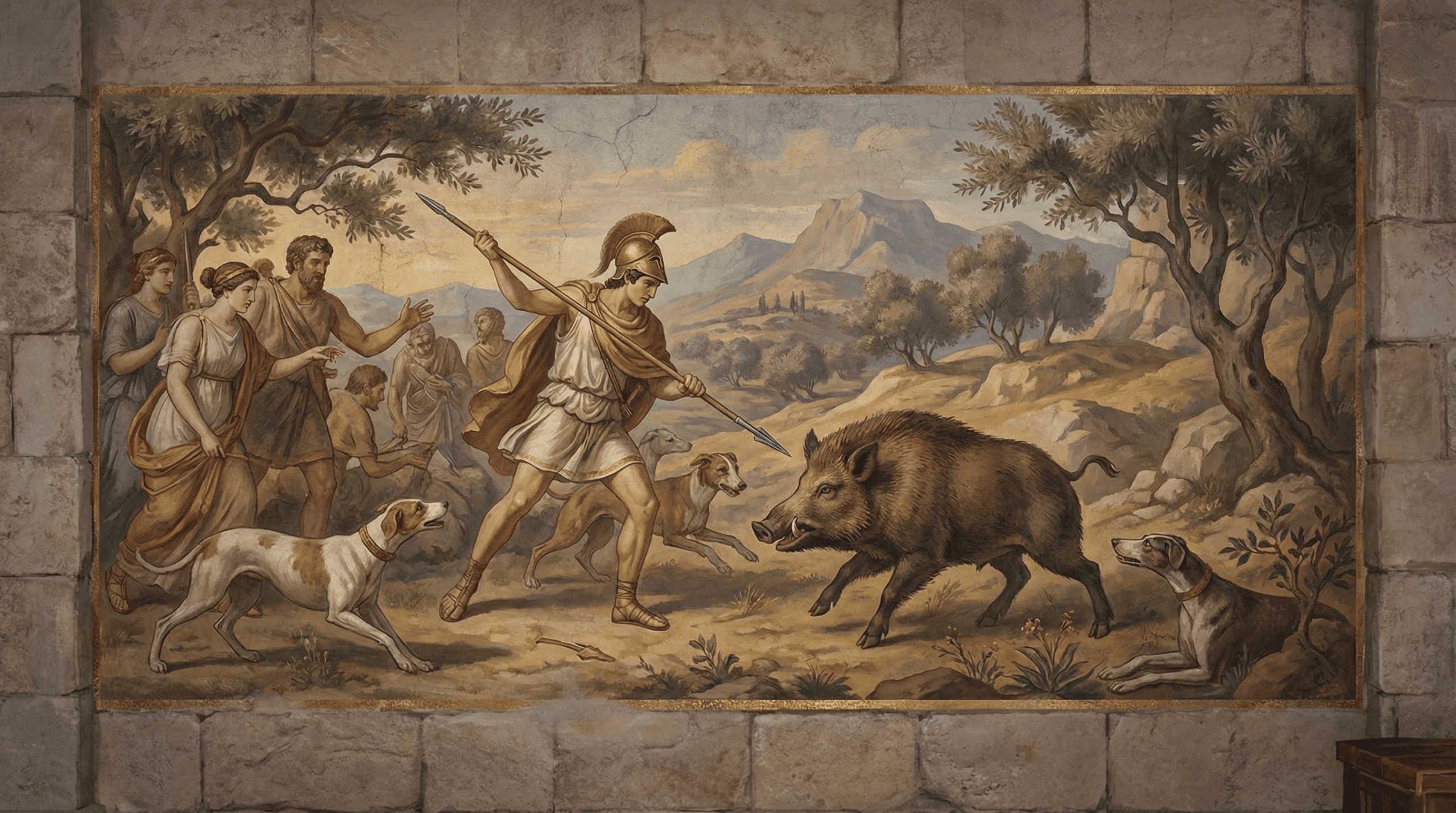
The Curse of the Burning Log: A Tale of Prince Meleager
When destiny is bound to flame, one mother must choose between vengeance and love
Part I: The Prophecy
The night Prince Meleager entered the world, Queen Althaea should have been celebrating. Instead, she found herself paralyzed with terror.
Three figures materialized from the shadows of her bedchamber, their forms flickering like smoke given shape. The Fates. Every mortal knew their names, whispered them in fearful prayers: Clotho, who spun the thread of life; Lachesis, who measured its length; and Atropos, who cut it short with her silver shears.
They never visited unless destiny demanded it.
The eldest Fate extended one gnarled finger toward the hearth where a log crackled merrily in the flames. When she spoke, her voice was ancient as stone.
Althaea’s scream caught in her throat. She lunged toward the fireplace, but before she could speak, before she could beg or bargain, the three figures dissolved into nothing.
Her hands trembling, she snatched the log from the flames, ignoring the searing pain across her palms. The wood was half-consumed, glowing orange at its core. She plunged it into a basin of water, watching steam hiss and rise like angry spirits.
That night, Althaea commissioned a chest of iron and locked the charred log inside. She wore the key on a chain around her neck, hidden beneath her robes, pressed against her heartbeat. A constant reminder. A terrible burden.
As long as this log survives, she told herself, my son cannot die.
Part II: The Pride of Calydon
Twenty years passed. Meleager grew into everything the Fates had promised—a warrior of extraordinary skill, a hunter without peer, a prince beloved by his people. He was also reckless, hot-tempered, and too proud by half.
Althaea watched him with a mother’s complex mixture of fierce love and quiet dread. Each time he rode into battle, each time he faced a new challenge, she would retreat to her chambers and check the chest. The log remained, sealed away in darkness, insurance against fate itself.
But she had forgotten one crucial truth: the gods are not mocked.
That autumn, during the annual sacrifices, King Oeneus made a catastrophic error. In his haste—or perhaps his hubris—he forgot to honor Artemis, goddess of the hunt. He left offerings for Zeus, for Athena, for Poseidon. But Artemis received nothing.
The goddess’s revenge came on four legs, with tusks like spears and eyes like coals.
The Calydonian Boar was no ordinary beast. It stood tall as a horse, its hide bristling with quills sharp as daggers. Lightning danced between its tusks when it roared. It tore through the countryside like a force of nature, trampling vineyards, goring livestock, and leaving broken bodies in its wake. Farmers fled their homes. Villages emptied. Terror spread like wildfire.
Nothing could stop it. Hunters who tried were found days later, unrecognizable.
Meleager knew this was no hunt for one man, no matter how skilled. This required an army.
Part III: The Gathering
Within a week, Greece’s finest warriors assembled in Calydon’s great hall. Meleager had called in every favor, invoked every bond of friendship and duty. They came.
Castor arrived on a magnificent stallion, his reputation as the greatest horseman in Greece preceding him. His twin brother Pollux came too, his fists said to be harder than bronze. There was Acastus, who could hurl a javelin through an oak trunk; Caeneus, the unconquerable; and Amphiaraus, whose prophetic visions had saved countless lives.
And then there was Atalanta.
She entered the hall in silence, but every head turned. She wore no royal finery, no elaborate armor. Just weathered leather, a bow across her back, and a hunter’s knife at her hip. Her eyes swept the room with the casual wariness of a predator in unfamiliar territory.
“A woman?” One of Meleager’s uncles, Plexippus, spat the word like poison. “You insult us, nephew. We’re here to hunt the gods’ own monster, not nursemaid some woodland wench.”
Before Meleager could respond, Atalanta spoke, her voice quiet but sharp as broken glass.
“I’ve killed more beasts than you’ve seen in your comfortable palace life, old man. Bears. Lions. Men who thought they could take what wasn’t offered.” She smiled without warmth. “Would you like a demonstration?”
His brother Toxeus stepped forward, hand on his sword. “Careful, girl. You forget your—”
“Enough.” Meleager’s command cut through the rising tension. He moved between them, eyes blazing with the same dangerous temper his mother feared. “Atalanta hunts with us. Anyone who objects can stay behind and explain to Calydon why they let cowardice rule them.”
The hall fell silent. No one moved.
Meleager turned to Atalanta, and something unspoken passed between them—recognition, respect, perhaps something more. “Tomorrow at dawn. Bring your best weapons. We end this.”
Because her father wanted a male heir, he abandoned her in the wilderness as an infant. Suckled by a bear and raised by roaming hunters, Atalanta became a fierce wrestler, swift runner, and lethal hunter. She had survived what should have killed her, and that survival forged her into something extraordinary—a warrior who needed no man’s approval and accepted no one’s limitations.
Part IV: Into the Beast’s Domain
The forest was wrong.
As the hunting party moved deeper into the woods, the wrongness pressed against them like a physical weight. No birds sang. No insects hummed. Even the wind seemed to hold its breath.
The boar’s trail was easy to follow—destroyed trees, torn earth, and the sickly-sweet stench of decay. The hounds, normally eager, whined and pulled at their leashes, desperate to flee.
“There,” Amphiaraus whispered, pointing toward a cave entrance that gaped like a wound in the hillside. “I saw it in my vision. The beast makes its lair inside.”
They spread out, forming a semicircle around the cave mouth. Nets were positioned, spears readied, bows drawn. Meleager felt his pulse quicken, that familiar thrill of the hunt singing through his veins.
Then came the sound.
A low rumble, like distant thunder, rolled from the cave’s depths. The ground trembled. Small stones skittered down the hillside.
The Calydonian Boar emerged into daylight, and for a heartbeat, no one moved. No one breathed.
It was worse than the stories. Larger. More terrible. Ancient rage made flesh.
The beast’s red eyes fixed on the warriors, and it charged.
Chaos erupted. The boar crashed through the nets as if they were cobwebs, scattering hunters like leaves. Its tusks caught a man—Ancaeus, brave Ancaeus—and tossed him into the air. He landed twenty feet away and didn’t move.
Javelins bounced off its hide. Spears shattered. The creature seemed invincible, unstoppable, more demon than animal.
Meleager found himself frozen, watching his carefully laid plans crumble. They were going to die here. All of them.
Then Atalanta moved.
While others scrambled and panicked, she became perfectly still. She nocked an arrow, drew her bow, and waited. The boar charged past her, close enough to kill, but she didn’t flinch. She tracked its movement, calculating, patient.
Behind its ear—there. A gap in the armor of its hide, where the quills didn’t quite meet.
She released.
The arrow flew true, burying itself deep. The boar’s charge faltered. It roared, a sound of pain and fury that shook the trees.
“Now!” Amphiaraus seized the moment, his own arrow finding the beast’s eye.
The boar stumbled, weakened but not defeated. It turned, seeking its tormentors, and in that instant Meleager saw his chance. He rushed forward, spear raised, and drove the point deep into the monster’s heart.
The great beast shuddered once, twice, and collapsed.
Silence fell over the forest, broken only by ragged breathing and distant groaning of the wounded.
They had done it. They had killed the unkillable.
Part V: The Fatal Prize
Back in Calydon, the celebration should have been magnificent. They’d saved the kingdom, defeated the gods’ punishment, earned immortal glory.
Instead, blood stained the palace steps before sunset.
Meleager stood before his assembled warriors, the boar’s massive head and hide at his feet. Tradition dictated he keep the prize, but his eyes found Atalanta in the crowd.
She’d made the crucial shot. She’d drawn first blood when others fell back. She’d turned the tide of battle.
“The prize,” Meleager announced, his voice carrying across the courtyard, “goes to Atalanta. Her skill saved us all. Her arrow wounded the beast when it seemed invincible. She deserves this honor.”
He lifted the hide and head, offering them to her. Atalanta stepped forward, surprise and something like gratitude softening her typically guarded expression.
“No.”
Plexippus and Toxeus, Meleager’s uncles, shoved through the crowd. Their faces were twisted with rage.
“She’s a woman,” Toxeus snarled. “An outsider. She doesn’t deserve—”
He snatched the hide from Meleager’s hands.
Everything inside Meleager went white-hot. The famous temper, the one his mother always warned him about, the one he’d struggled his whole life to control—it slipped its leash.
“Give. It. Back.”
“Make me, boy.” Plexippus moved to stand beside his brother, hand on his sword. “Or are you too distracted by a pretty face to remember family honor?”
The insult struck like a slap. Meleager’s vision narrowed to a pinpoint. His hand moved to his own weapon.
“Don’t.” Atalanta’s voice, urgent and low. “It’s not worth it. I don’t need—”
But Meleager wasn’t listening. He was drowning in rage, in wounded pride, in the intoxication of righteous fury.
Steel rang. Once. Twice.
When his vision cleared, when the red haze lifted, when the world came back into focus—
His uncles lay dead at his feet.
Part VI: The Mother’s Vengeance
Althaea heard the commotion before she heard the news. The wailing. The horrified whispers. She ran from the palace, her heart in her throat, certain her son had fallen.
Instead, she found him standing over her brothers’ bodies, sword still in hand, blood still fresh.
The crowd parted as she approached. Everything slowed, became crystal clear in the worst possible way. Plexippus’s sightless eyes. Toxeus’s hand still reaching for a weapon he’d never drawn. Meleager, her son, her precious boy, trying to explain in a voice ragged with shock.
“Mother, I— They insulted— I didn’t mean to—”
But she couldn’t hear him. The roaring in her ears drowned out everything else.
Her brothers. Her blood. Her childhood companions who’d taught her to ride, who’d protected her, who’d loved her.
Dead by her son’s hand.
Althaea turned without a word and walked back into the palace. Her vision tunneled. Her hands shook. With each step, grief transformed into something darker, hotter, more terrible.
He killed them. My own son killed my brothers.
She found herself in her chambers without remembering the journey. Her fingers moved to the key around her neck—the key she’d worn for twenty years, the key to her son’s life.
The chest opened with a creak of hinges.
The charred log lay inside, exactly as she’d left it two decades ago. Waiting. Patient. Inevitable.
He deserves this, a voice whispered in her mind. Justice. Balance. Blood for blood.
But another voice, smaller, more desperate: He’s your son. Your child. The boy you nursed and raised and loved.
Her hands trembled as she lifted the log. It was lighter than she remembered. Fragile.
From outside came the sounds of mourning, of chaos, of everything falling apart.
Althaea walked to the hearth.
She stood there for a long moment, the log in her hands, tears streaming down her face. Every memory of Meleager flashed through her mind—his first steps, his first words, his first hunt. His laugh. His stubbornness. His pride.
His terrible, fatal pride.
“Forgive me,” she whispered. But whether she spoke to her son or her brothers, even she didn’t know.
She dropped the log into the flames.
Epilogue: The Burning
Miles away, Meleager staggered as if struck. The sword fell from his nerveless fingers.
“What—” He looked down at his hands, saw nothing wrong, but felt everything failing.
Heat. Unbearable heat, like his blood had turned to fire. Like his bones were kindling. Like something ancient and terrible was consuming him from the inside out.
He fell to his knees. Around him, warriors rushed forward, calling for physicians, for priests, for anyone who might help. But Atalanta knew. Somehow, she knew. She knelt beside him, took his hand, and said nothing.
Meleager’s mind raced, fragments of memory and understanding clicking into place. The Fates. The prophecy his mother never spoke of but always feared. The reason she checked her chambers every night, the reason she wore that key like a talisman.
Oh, Mother. What have you done?
What have I forced you to do?
The fire spread through him, erasing thought, erasing pain, erasing everything. His last sensation was Atalanta’s hand in his, steady and strong and too late.
When the log in Queen Althaea’s hearth crumbled to ash, Prince Meleager of Calydon breathed his last.
She had avenged her brothers. She had executed justice. She had destroyed her son.
She had destroyed herself.
The Fates, watching from their domain beyond mortal sight, nodded to one another. The thread had been measured. The thread had been cut. Destiny, as always, was satisfied.
But in the ashes of that hearth, in the ruins of that family, in the terrible price of pride and rage and vengeance—there was no satisfaction to be found.
Only grief. Only endings.
Only the cruel truth that some fires, once lit, consume everything.
Love Greek Mythology?
Discover more tragic tales and epic heroes from ancient Greece.
From the hubris of Icarus to the sacrifice of Iphigenia, explore the timeless stories that have captivated readers for thousands of years. These aren’t just myths—they’re warnings about pride, warnings about fate, and reflections on the human condition that remain relevant today.