
Antigone: The Girl Who Defied a King
When duty to family clashes with obedience to the throne, one princess will risk everything for what she believes is right
Prologue: A City Mourns
Dawn broke over Thebes like a wound—red and bleeding across the horizon. The air still reeked of death, of blood soaked into earth, of smoke from funeral pyres that would never be lit for all the fallen.
The battle was over. The war had ended. But peace had not come.
Outside the city gates, vultures circled. Their shadows swept across the plain where bodies lay scattered like discarded toys. Among them, one corpse received special attention from the carrion birds. One body lay isolated, surrounded by a ring of guards who stood watch with spears and grim expressions.
Polyneices, prince of Thebes, traitor to his city, brother to the king who lay dead beside him. His eyes stared sightlessly at the sky, his mouth frozen in a final cry of rage or pain or both.
By order of King Creon, he would remain there. Unburied. Unmourned. A feast for scavengers and a warning to all who might dare defy royal authority.
The new king had spoken: anyone who touched the traitor’s corpse would be stoned to death in the public square.
But the gods had other plans. And those plans centered on a young woman who had already lost everything except her sense of what was right.
Part I: The Cursed Family
To understand Antigone’s story, you must first understand her family—a bloodline so cursed that the gods themselves watched with a mixture of fascination and horror as each generation stumbled toward its doom.
Her father, Oedipus, had been king of Thebes. A good king, a just ruler, a man who’d saved the city from the Sphinx’s terror. But he carried a secret so terrible that when it was finally revealed, it shattered everything.
Oedipus had killed his father and married his mother, all without knowing the truth until it was far too late. When he finally understood what he’d done, he tore out his own eyes and wandered into exile, leaving his children to inherit not just a kingdom, but a legacy of shame and tragedy.
Instead, they’d done what the cursed sons of Oedipus were always going to do: they destroyed each other.
Eteocles claimed the throne and refused to yield it. Polyneices raised an army and marched on his own city. Brother fought brother at the gates of Thebes, and in the end, they killed each other in single combat—their swords piercing each other’s hearts in the same terrible moment.
Which left their uncle Creon to pick up the pieces.
And their sisters—Antigone and Ismene—to survive in a world that no longer wanted them.
Part II: The Edict
The morning after the battle, Antigone woke to the sound of heralds in the streets below her window.
She didn’t need to listen to know what they were announcing. She’d seen the look in Creon’s eyes the night before when he’d claimed the throne. Pride. Certainty. The dangerous conviction of a man who believed might made right.
Still, hearing the words made them real.
“By order of King Creon, Eteocles, defender of Thebes, will be buried with full honors. His brother Polyneices, traitor and enemy of the state, is denied all funeral rites. His body will remain where it fell, food for dogs and birds. Any person who attempts to bury him will be executed by stoning. So speaks the king. So shall it be.”
Antigone’s hands clenched around the edge of her window frame. Her knuckles went white.
In the streets below, people whispered. Some nodded, accepting Creon’s authority. Others looked away, uncomfortable but unwilling to challenge the new king. Fear had settled over Thebes like a fog, thick and suffocating.
But Antigone felt something else entirely. Rage. Pure, white-hot rage that burned away everything else.
She crossed to her sister’s room without bothering to knock.
Ismene sat on her bed, her face pale and drawn, her hands folded in her lap like a girl waiting for judgment. She looked up when Antigone entered, and something in her expression said she already knew why her sister had come.
“Don’t,” Ismene whispered. “Whatever you’re thinking, Antigone, don’t.”
“He was our brother.”
“He attacked our city. He tried to destroy—”
“He was our BROTHER.” Antigone’s voice cracked. “Both of them were. Eteocles gets a hero’s funeral while Polyneices rots in the sun? What kind of justice is that?”
“It’s Creon’s justice. He’s king now.”
“He’s a tyrant.” Antigone began to pace, her mind already racing through possibilities, plans, desperate gambits. “The gods demand we bury our dead. Divine law—”
“Antigone.” Ismene stood, moving to block her sister’s path. Her voice dropped to a desperate whisper. “We’re girls. Orphans. We have no power, no protection. If you defy Creon, he’ll kill you. And I can’t—” Her voice broke. “I can’t lose you too. You’re all I have left.”
For a moment, Antigone’s expression softened. She reached out and touched her sister’s face, a gesture of tenderness that made Ismene’s eyes fill with tears.
“Then help me. Come with me tonight. We’ll bury him together.”
But Ismene shook her head, stepping back as if her sister had struck her. “I can’t. I’m sorry, I can’t. It’s suicide.”
“It’s family.”
“Then you’ll die for family. And I’ll die here, alone, knowing I could have stopped you.”
Antigone studied her sister for a long moment. Then she turned and walked toward the door.
“Where are you going?” Ismene called after her.
“To do what needs to be done. With or without you.”
Part III: The First Attempt
Midnight. The city slept.
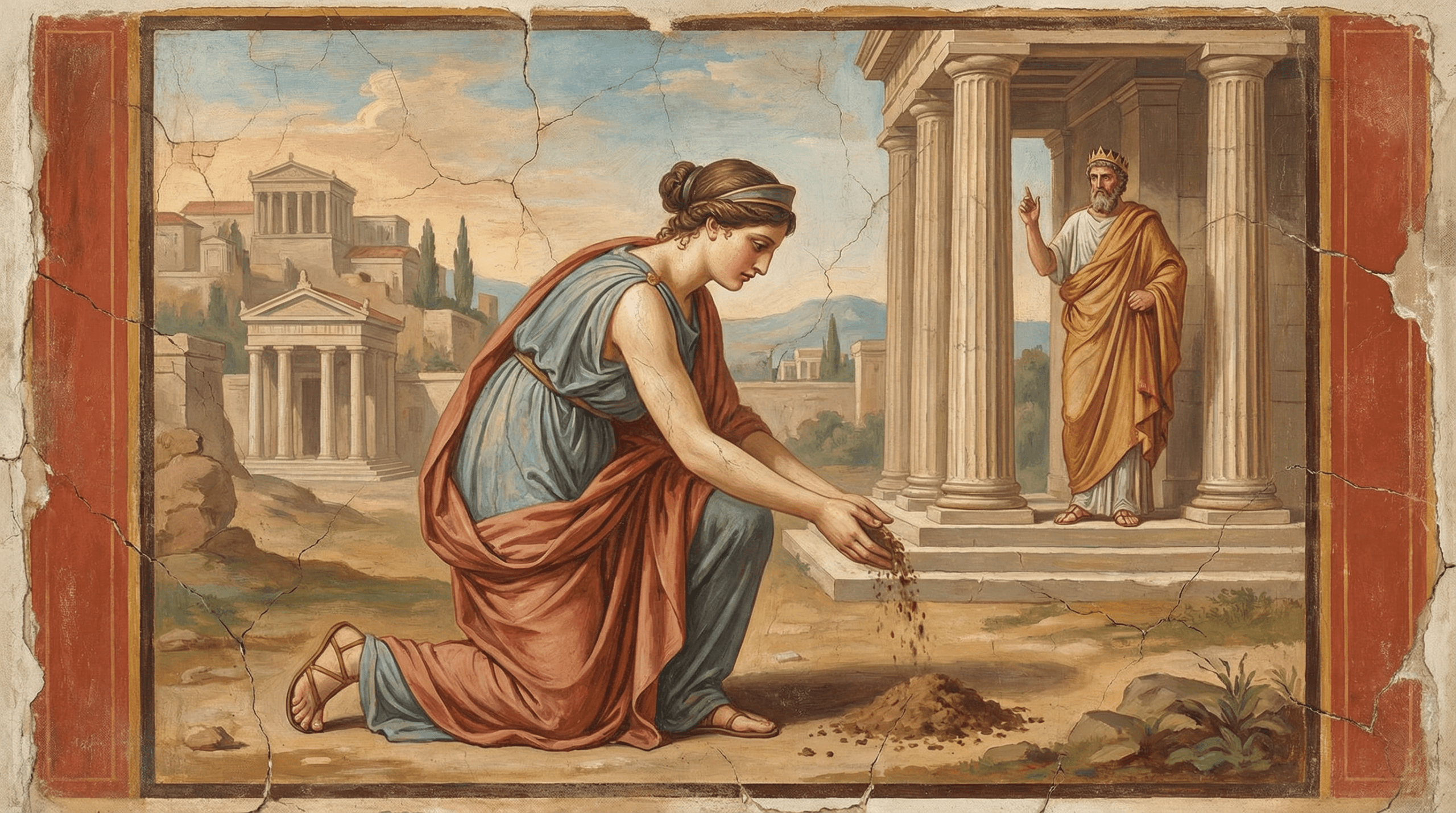
Antigone slipped from the palace like a shadow, her dark cloak pulled tight around her, a small clay jar clutched in her hands. Inside: dust and earth, the symbolic elements of burial.
She knew the risks. Guards surrounded Polyneices’ body, watching for anyone foolish enough to try what she was attempting. But Antigone had grown up in the palace. She knew secret ways out, forgotten paths that wound through the lower city.
More importantly, she didn’t care about the risks. Fear had no power over someone who had nothing left to lose.
The plain outside the gates was eerily silent. The guards had built small fires to keep warm, and their voices drifted across the darkness—bored men, tired men, men who thought their duty was pointless because who would be stupid enough to defy the king?
Antigone moved between the pools of firelight, keeping to the shadows. Her heart hammered so hard she was certain everyone could hear it, but she forced herself to stay calm, to breathe, to focus on the task ahead.
There. Polyneices’ body, a dark shape against darker ground.
She waited, watching the guards’ patterns, learning their rhythms. When two of them wandered away to relieve themselves and another turned to warm his hands at a fire, she moved.
Kneeling beside her brother’s corpse was the hardest thing she’d ever done. Not because of the smell—though death’s perfume was thick and sickening. Not because of the violence evident in his wounds—though they were terrible to see.
No, it was hard because he looked so young. So human. So much like the boy she remembered from childhood, before ambition and pride and their father’s curse had twisted everything into tragedy.
“I’m sorry. I’m so sorry it came to this.”
She sprinkled the dust over his body in the traditional manner, whispering the prayers to guide his soul to the underworld. It wasn’t a proper burial—not even close—but it was something. A gesture. A defiance of Creon’s cruel edict.
Divine law honored. Human law broken.
When she finished, she pressed her hand to the cold earth beside him.
Then she ran.
Part IV: Discovery and Defiance
The guards discovered the disturbance at dawn. Dust on the corpse. Obvious signs that someone had performed burial rites.
Chaos erupted. Accusations flew. Who had failed in their duty? Who had fallen asleep? Who had let this happen?
Creon’s rage was incandescent. He screamed at the captain of the guard until the man’s face went white. Then he issued his orders, sharp and unforgiving.
“Find who did this. Bring them to me. I don’t care if it takes all day. Someone defied my order, and they will answer for it.”
The guards doubled their watch. Tripled it. They questioned everyone who’d been near the gates. But they found nothing—no witnesses, no evidence, no clues.
So Antigone waited. And at midday, when the sun was at its peak and the guards were squinting against the glare, she returned.
This time, she brought water. A proper burial required more than dust. It required the full rituals, the complete rites. She would give her brother that much, even if it cost her everything.
She was halfway across the plain when the storm hit.
It came from nowhere—or perhaps from everywhere. The sky darkened. The wind howled. Dust whirled up from the earth in a blinding, choking cloud that reduced visibility to nothing.
The guards shouted in confusion, covering their faces, trying to see through the tempest. But the storm seemed almost alive, almost intelligent, as if the gods themselves had conjured it to aid Antigone’s mission.
She worked quickly, pouring water over Polyneices’ corpse, covering it with more earth, speaking the final prayers. Her hands shook. Tears streamed down her face, mixing with dust and sweat.
“Rest now, brother. Your soul is free.”
Then, as suddenly as it had appeared, the storm vanished. The dust settled. The sun blazed down from a clear sky.
And the guards, blinking in the sudden light, saw her.
A girl. Kneeling beside the traitor’s corpse. Her hands covered in dirt. Her face streaked with tears and dust.
The princess Antigone.
For a frozen moment, no one moved. The guards stared in shock. Antigone met their eyes with a strange, calm defiance.
Then the captain found his voice.
“Seize her. Take her to the king.”
Part V: Before the Throne
They dragged her through the palace gates like a common criminal. Word spread ahead of them—the guards’ shouts, servants’ gasps, the whispers that raced through corridors faster than any messenger could run.
By the time they reached the throne room, a crowd had gathered. Nobles. Soldiers. Citizens who’d pushed their way in to witness this impossible scene.
Creon sat on his new throne, his face a mask of fury barely held in check. His knuckles were white where they gripped the armrests. When Antigone was thrown to her knees before him, he rose slowly, like a judge pronouncing sentence.
“You. You dare?”
Antigone lifted her head. Her eyes met his without flinching. “I dare.”
“I issued a proclamation. A lawful order from your king. You heard it?”
“I heard it.”
“And you chose to violate it anyway. To defy my authority. To spit in the face of my rule.” He descended from the throne, circling her like a predator. “Do you understand what you’ve done? What you’ve forced me to do?”
“I understand perfectly. I buried my brother. As was my duty. As the gods demand.”
“The gods?” Creon’s laugh was harsh. “You lecture me about the gods? Your brother was a traitor! He brought war to our doorstep, killed his own brother, tried to destroy this city! And you speak to me of duty?”
“He was my blood. Divine law is older than any king, stronger than any decree. I will not apologize for honoring it.”
A commotion at the entrance made everyone turn. Ismene burst into the throne room, her eyes wild, her hair disheveled. She threw herself at Creon’s feet.
“It was me! I helped her! I’m guilty too! If you punish her, you must punish me!”
“Ismene, no—” Antigone started.
But Creon silenced them both with a raised hand. He studied Ismene for a long moment, then slowly shook his head.
“Liar. You didn’t have the courage.” He turned back to Antigone. “She acted alone. And she’ll pay alone.”
“Then I’ll pay gladly. Better to die following divine law than live under your tyranny.”
The crowd murmured. Some in shock, some in grudging admiration. A few looked away, uncomfortable with her defiance but unwilling to support it.
Then another voice cut through the tension.
“Father. Please.”
Haemon, Creon’s son, stepped forward. He was pale but composed, his hands clenched at his sides. He’d arrived too late to stop Antigone, too late to change anything, but not too late to try to save her.
“She’s my betrothed. We’re to be married. Surely there’s another way—”
“There’s no other way.” Creon’s voice was iron. “She broke the law. Openly. Deliberately. If I show mercy now, I show weakness. And weakness in a king is death.”
“But—”
“Enough!” Creon roared. “I am your father and your king! You will not question my judgment!”
Haemon’s jaw tightened. He looked at Antigone, and something passed between them—recognition, regret, a wordless goodbye.
“Then I question nothing. Except what kind of king you’ve become.”
He turned and walked from the throne room, leaving a terrible silence in his wake.
Part VI: The Sentence
Creon knew he had a problem. If he executed Antigone directly—had her stoned in the public square as his law demanded—there would be questions. Sympathy for the orphaned princess. Doubt about his rule.
But if he showed mercy, his authority would crumble. Other laws would be challenged. His reign would be built on sand.
So he chose a third option. One that allowed him to maintain his cruel justice while avoiding direct blame.
“Take her to the caves at the edge of the city. Seal her inside with enough food and water for three days. The gods will decide her fate.”
It was a death sentence dressed up as divine judgment. Antigone would starve or suffocate in the darkness, and Creon could claim he’d left her life in the gods’ hands.
As the guards moved to obey, Ismene threw herself at her sister. They embraced, both of them crying, neither able to speak the words that needed to be said.
“I’m sorry. I should have been braver. I should have stood with you.”
“You’re here now. That’s enough. Take care of yourself, sister. Live. For both of us.”
Then the guards tore them apart, and Antigone was led away toward her death.
She thought of Haemon, the boy she’d been promised to but would never marry.
And she thought of what she’d done. The defiance. The choice. The price.
She had no regrets.
Part VII: The Prophet’s Warning
On the morning of the fourth day, Tiresias arrived.
The blind prophet was ancient beyond reckoning, his face lined with the accumulated wisdom and sorrow of centuries. He walked with a staff and was led by a young boy, but when he entered Creon’s presence, there was nothing frail about him. Power radiated from him like heat from a forge.
“King Creon, I come with warnings from the gods.”
Creon, who’d spent three sleepless nights questioning his decision, bristled at the prophet’s tone. “Then speak, old man. I have matters of state to attend to.”
“Your matters of state are poisoning this city. The gods are angry. You’ve left a corpse to rot above ground, polluting sacred earth. You’ve buried a living girl in a tomb. You’ve inverted the natural order—given death to the living and life to the dead.”
“I did what was necessary! What any strong king would do!”
“You did what your pride demanded. And now the Furies wait, King Creon. The avenging spirits who punish hubris. They circle your throne like vultures. They whisper your name in the darkness.”
Something in the prophet’s words cut through Creon’s defenses. Fear, cold and primal, crept up his spine.
“What must I do?”
“Free the girl. Bury the corpse. Humble yourself before the gods you’ve offended. Do this now, without delay, and perhaps—perhaps—they will show mercy.”
“And if I refuse?”
Tiresias turned to leave, his young guide helping him toward the door. Just before he crossed the threshold, he spoke one final time.
“Then steel yourself for grief, King Creon. For you will pay for your pride with blood. The blood of those you love most.”
The prophet’s words hung in the air like a curse.
And Creon, at last, broke.
Part VIII: Too Late
Creon scrambled to undo his mistakes, shouting orders, gathering men, racing against a doom he could suddenly feel closing in around him.
First, they went to bury Polyneices. The corpse, after days in the sun, was a horror. But they gave it the proper rites, covering it with earth, speaking the prayers, appeasing the gods who’d been offended by its abandonment.
Then they rushed to the caves where Antigone had been sealed.
Creon led the way, his heart hammering, Tiresias’s warning echoing in his mind. The blood of those you love most.
They tore away the rocks blocking the cave entrance. Torchlight spilled into the darkness, illuminating—
No.
Haemon knelt in the center of the cave, cradling Antigone’s body. She hung from a noose made from her own wedding veil, the delicate fabric that should have crowned her as a bride now serving as her death shroud.
She’d chosen her end rather than wait for starvation. Dignified. Defiant. Free.
Haemon looked up as they entered, and the expression on his face stopped them all in their tracks. It was beyond grief. Beyond rage. It was the look of someone whose world had just ended.
“You. You’re too late. As you always are.”
“Son—” Creon stepped forward, hands outstretched. “I tried. As soon as the prophet spoke, I came. I—”
Then, still holding Antigone, Haemon drew his sword.
“No!” Creon lunged forward, but his son was faster.
Haemon swung the blade at his father with all the rage and grief in his broken heart. Creon dodged, stumbling backward, and the sword missed by inches.
For a moment, father and son stared at each other. Then Haemon’s face twisted, and he turned the blade inward.
The sword pierced his own chest. He gasped once, blood blooming across his tunic, and collapsed beside Antigone. With his last strength, he reached out and took her hand, his fingers intertwining with hers in death as they never had in life.
Creon fell to his knees. Around him, his guards stood frozen, unable to process what they’d just witnessed.
“No. No, no, no…”
But the gods were not finished with him yet.
Epilogue: The Price of Pride
Word reached Thebes before Creon could return. Haemon was dead. The prince, the heir, the beloved son—gone.
Queen Eurydice heard the news as she made offerings at an altar. For a moment, she simply stood there, unmoving. Then, very calmly, she picked up the ceremonial knife.
“Tell my husband that I curse him with my final breath. Tell him he’s destroyed everything he ever loved. Tell him—”
She drew the blade across her throat before anyone could stop her.
She was dead before her body hit the ground.
They brought the news to Creon as he stumbled back through the palace gates, still covered in his son’s blood, still broken by what he’d witnessed in that cave.
“Your wife, my lord. The queen. She’s… she’s gone.”
Something inside Creon shattered completely. He fell, hands clutching at the ground, a keening wail tearing from his throat. Everything he’d done to maintain his power, every cruel decision made in the name of strength and authority—it had all led here. To this moment. To this loss.
His son, dead. His wife, dead. His city, haunted by grief.
And Antigone, the girl he’d condemned for following her conscience, had won after all. Her defiance had exposed his tyranny. Her death had triggered his downfall. Her courage had proven stronger than his crown.
Creon had thought himself above divine law. He’d believed might made right, that kingship granted him the authority to override ancient custom and moral duty.
He’d learned, too late, that some laws are older than kings. Some truths are stronger than thrones. And some girls, even powerless and alone, can shake the foundations of empires.
His attendants helped him to his feet—a broken man wearing a crown, a king with nothing left to rule. They led him back into the palace, back to his empty throne room, back to the throne that had cost him everything.
Behind them, Thebes mourned. For Antigone, the righteous rebel. For Haemon, the loyal son. For all the tragedy that pride and power had wrought.
And above, the gods nodded to one another. Justice, in the end, had been served. Not through mercy or wisdom or compassion—but through the terrible, inevitable consequences of hubris.
Discover More Greek Tragedies
Explore timeless stories of defiance, fate, and the human condition.
The story of Antigone ended the way so many Greek tragedies end: with bodies, with grief, with the bitter knowledge that the gods always win in the end. But her defiance lived on—a reminder that sometimes, doing what’s right requires standing against everyone and everything.