
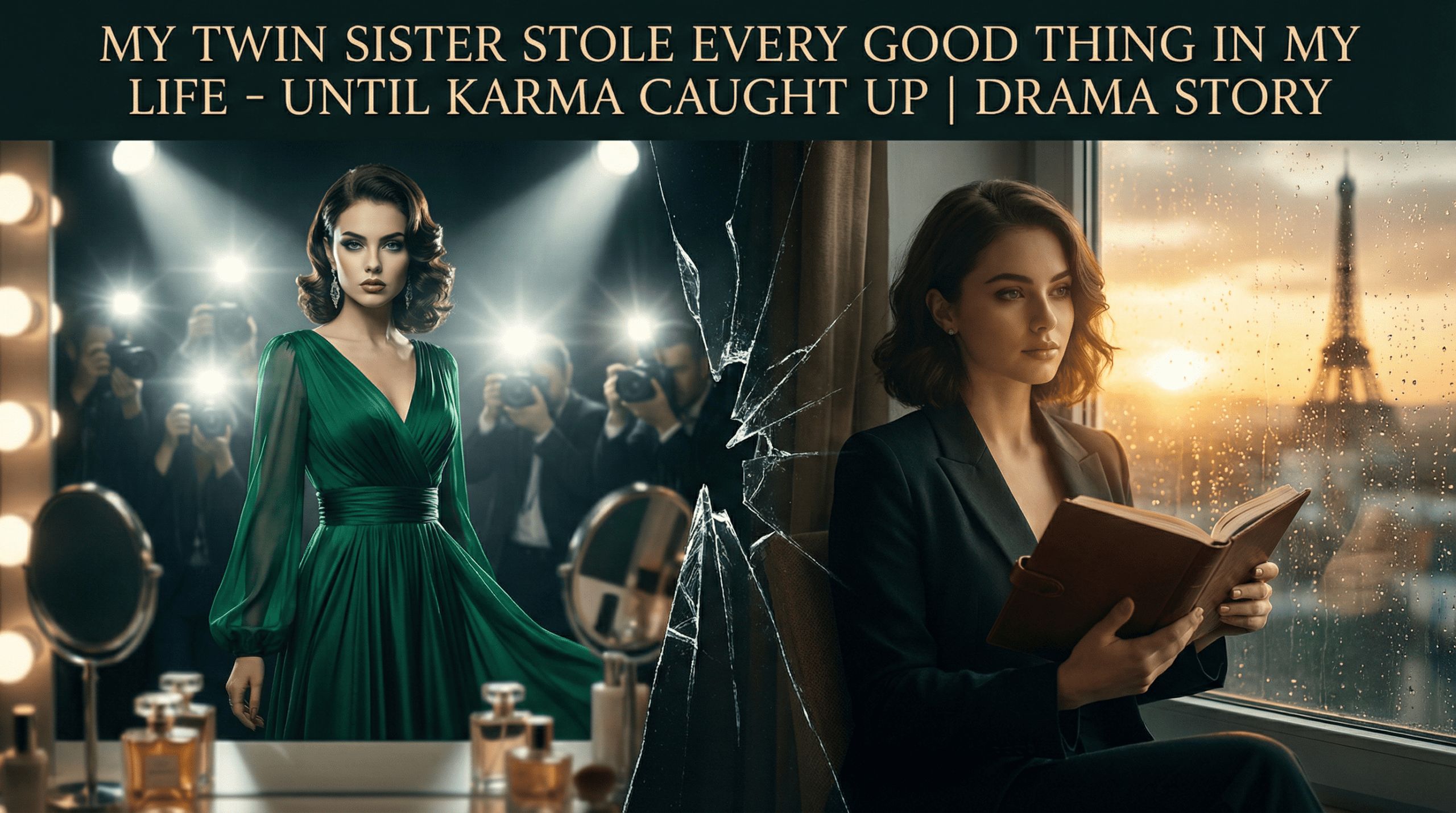
My Twin Sister Stole Every Good Thing in My Life — Until Karma Caught Up
She was the supermodel. I was the invisible one. But the night she revealed who she truly was, everything changed — and it all started with a boy she never deserved.
Chapter 1: The Golden Twin and the Invisible One
People say being a twin is like having a built-in best friend for life. People are wrong. Sometimes being a twin means having a front-row seat to watching someone who shares your face live the life you were never allowed to have.
My name is Tanya Moreau, and I grew up on Manhattan’s Upper East Side in a penthouse that overlooked Central Park. My father, Richard Moreau, was a self-made businessman who’d turned a single clothing store into a fashion empire. My mother, Colette, was a former supermodel from Lyon, France — stunning, dramatic, and, to put it gently, a little unhinged.
And then there was my twin sister, Natasha.
Natasha and I were identical in every physical way: the same dark hair, the same green eyes, the same sharp jawline we’d inherited from our mother. But that was where the similarities ended. Where I buried myself in books, Natasha buried herself in mirrors. Where I dreamed of writing stories that would change the world, Natasha dreamed of walking runways that would worship her.
And our mother made sure only one of those dreams mattered.
“Oh, chérie, you cannot imagine. The gardens of Versailles, the light on the Seine at sunset, the little patisseries on every corner. France is not a country. It is a feeling.”
I fell in love with the language, the culture, the history. I started teaching myself French from library books. I filled journals with stories set in Paris. I begged my father every birthday, every Christmas, every report card day: Please, Dad, can we go to France? Just once?
His answer was always the same gentle deflection. But it was my mother who delivered the real verdict.
“Not this year, darling. Maybe when Natasha becomes a famous model, we’ll all go to Paris Fashion Week together.”
She wasn’t joking. She never was.
My mother’s obsession with Natasha’s modeling career started before we could walk. By age three, Natasha was competing in baby pageants. By five, her face was on cereal boxes across the country. By eight, she had an agent, a stylist, and an ego the size of the Empire State Building.
And me? I had a library card and a growing understanding that in our family, there was only room for one star.
Chapter 2: The Little Tyrant
The worst part about Natasha’s fame wasn’t the way it inflated her ego. It was what it did to the people around her — people who couldn’t fight back.
At school, she walked through the hallways like she owned the building. Students parted for her. Teachers hesitated to correct her. She’d perfected a fake French accent that she deployed whenever she wanted to sound sophisticated, which was constantly, and which sounded about as authentic as a three-dollar bill.
But the incident I’ll never forget happened at home, the summer we were twelve.
Our family employed a full-time housekeeper named Maria, a quiet, hardworking woman who’d immigrated from Guatemala with her young son, Diego. Diego was ten — a shy, sweet kid who sometimes helped his mother around the estate on weekends. He loved our garden. He’d spend hours out there, carefully watering the roses, talking to the plants like they were his friends.
One Saturday afternoon, I was reading on the porch when I heard Natasha screaming.
I ran outside to find her towering over Diego, who was holding a single white rose in his trembling hand. He’d picked it for his mother’s birthday.
“How dare you touch my flowers! Didn’t your mother teach you that stealing is a crime? I should call the police on you!”
Diego’s eyes were wide with terror. He couldn’t have been more than four feet tall, clutching that little rose like a lifeline.
“You’re fired! Both of you — you and your mother. Get out of my house!”
I stepped between them. “Natasha, stop it. He’s a kid. It’s one flower.”
“Stay out of this, Tanya. If he steals flowers today, what’s next? My jewelry? My clothes?”
“He picked a rose for his mom’s birthday. You’re being cruel.”
Natasha’s lip curled. She looked at Diego with such contempt that I felt physically sick. Then she turned on her heel and marched inside to tell our mother.
By the next morning, Maria and Diego were gone. Our mother had let them go — not because she agreed with Natasha, but because it was easier than dealing with one of Natasha’s tantrums.
I found Diego’s little watering can by the garden gate. He’d left it behind in the rush to pack. I kept it on my windowsill for years, a reminder of the kind of person I never wanted to become.
Chapter 3: Dad’s Secret Gifts
If my mother was the architect of Natasha’s empire, my father was the ghost in our family — always present in theory, always absent in practice. He traveled constantly for work: Tokyo one week, London the next, Dubai the week after. He missed school plays, parent-teacher conferences, and more dinners than I could count.
But he tried, in his own quiet way, to make up for it. Especially with me.
Every time he came home from a trip, he’d bring lavish gifts for both of us — designer bags for Natasha, gadgets and books for me. But late at night, when the house was dark and everyone else was asleep, he’d slip into my room and leave something extra on my nightstand.
I sat up, my eyes wide. “Dad, this must have cost—”
“Don’t worry about that. I saw it and thought of you immediately.” He tucked a strand of hair behind my ear. “You remind me of your mother, you know. The version of her that fell in love with stories before she fell in love with cameras.”
“Thanks, Dad. I love you.”
“I love you too, princess. More than you know.”
He kissed my forehead and slipped out as silently as he’d come.
For a long time, those midnight gifts were enough. But as I got older, I started to see them for what they really were: apologies. Silent, beautiful apologies from a man who knew his daughter was drowning in his own house but didn’t know how to save her without capsizing the boat.
I stopped being angry at him around the same time I stopped expecting things to change. Sometimes acceptance is quieter than forgiveness, and a lot less satisfying.
Chapter 4: Sweet Sixteen and the Boy With Blue Eyes
The year Natasha and I turned sixteen, our parents threw us a birthday party so extravagant it could have funded a small country. Our penthouse was transformed into a glittering wonderland — crystal chandeliers, a live band, a five-tier cake that was taller than I was. Three hundred guests filled the rooms, most of whom I’d never met.
Natasha, naturally, was in her element. She’d tried on no fewer than twenty dresses before settling on a custom emerald gown that our mother had flown in from Milan. She moved through the crowd like a queen holding court, every gesture practiced, every smile calculated.
I sat in the corner of the library with a copy of The Count of Monte Cristo and a plate of appetizers, perfectly content to let the party happen around me.
My father found me there around nine o’clock, looking apologetic.
“I’m sorry about the iPad, sweetheart. The shipment got delayed. It’ll be here tomorrow.”
“It’s fine, Dad. Really.”
He sat down beside me. “There’s someone I want you and your sister to meet. Come on.”
He led me to the main living room, where Natasha was already holding court with a group of admirers. Standing next to my father’s old friend — a man named Charles Ashford, who ran one of the most prestigious modeling agencies in Los Angeles — was a boy.
And everything in the room seemed to go quiet.
His name was Ryan Ashford. He was sixteen, with the kind of face that didn’t seem real — sharp cheekbones, deep blue eyes that caught the light like sapphires, and dark hair that fell across his forehead in a way that looked effortless but probably wasn’t. He was tall, broad-shouldered, and when he smiled, it was the kind of smile that made you forget what you were saying.
I’d never reacted to a boy like that before. I was the girl who read romance novels, not the girl who lived them. But something about Ryan Ashford short-circuited every logical part of my brain.
“Ryan will be transferring to your school starting Monday,” my father announced. “I’d appreciate it if you two could show him around.”
Natasha’s eyes locked onto Ryan like a hawk spotting prey. But I noticed something strange — she wasn’t looking at Ryan the way a girl looks at a boy she finds attractive. She was looking at him the way a chess player looks at a useful piece.
“I would love to show him around, Daddy,” Natasha cooed, looping her arm through Ryan’s before he could even introduce himself. “Don’t worry about a thing.”
Ryan caught my eye over Natasha’s shoulder and gave me a small, slightly bewildered smile. I looked away quickly, my cheeks burning.
Later that night, passing my mother’s dressing room, I heard a conversation that killed whatever butterflies had started fluttering in my stomach.
“Already ahead of you. He’s cute enough, I suppose. A little dim, but that makes it easier.”
They laughed together — a sound like breaking glass.
I stood in the hallway, my hand on the wall to steady myself. Whatever small, stupid hope I’d been nurturing died right there, quietly, in the dark. Ryan Ashford wasn’t a person to them. He was a stepping stone.
And I wasn’t going to compete with that. I wasn’t going to compete with Natasha ever again.
Chapter 5: The Arm Candy Effect
Ryan’s first day at Westhaven Academy was exactly what you’d expect. He walked through the front doors and the entire student body collectively lost its mind.
Girls whispered. Boys stared. Phones came out. Within an hour, someone had already created a fan account for him on social media, which would have been flattering if it wasn’t deeply unsettling.
And Natasha — who had never once in her life helped another human being without a motive — appointed herself his personal tour guide, protector, and social director. She was glued to his side from homeroom to final bell, steering him through the hallways with a possessive hand on his arm.
Ryan, for his part, seemed genuinely smitten. He followed Natasha around with the eager devotion of a golden retriever, fetching her coffee, carrying her bags, laughing at jokes she didn’t even make. He was kind, earnest, and hopelessly naive — the worst possible combination for someone caught in my sister’s web.
I watched it all from a safe distance, burying whatever complicated feelings I had under layers of schoolwork and sarcasm.
One afternoon in the cafeteria, I overheard an exchange that perfectly summarized their dynamic.
“Ryan, honey, can you get me my salad? But remember — light dressing, no croutons, no cheese. I cannot afford a single extra calorie before my shoot this weekend.”
“Coming right up, princess!”
He returned five minutes later with a fully loaded cheeseburger and a chocolate milkshake.
Natasha stared at the tray like he’d placed a live grenade in front of her. The entire table went silent.
“What… is this?”
“Your lunch! You said you wanted something good, right?”
Natasha’s eye twitched. For a moment, I thought she might actually throw the milkshake at him. But then she remembered who his father was, forced a smile so tight it could have cracked porcelain, and pushed the tray away.
“You’re so sweet, babe. But I’ll just have water.”
I turned back to my book, but not before catching Ryan’s confused, crestfallen expression. And despite everything — despite knowing he was too oblivious to see what was right in front of him — my heart ached for him.
Whatever tiny crush I’d been nursing? I told myself it was dead. He was beautiful and kind, but he was also completely under Natasha’s spell. And I didn’t have the energy to fight for someone who couldn’t see the difference between genuine love and a performance.
Or so I thought.
Chapter 6: The School Musical That Changed Everything
Two months into the semester, I was drowning. Not in the dramatic, romantic way — in the very literal, unglamorous, “I haven’t slept more than four hours in a week” way.
Our school’s annual musical was approaching, and I was the lead writer. I’d spent months crafting the script — a story about two people from different worlds who find each other through music. It was personal, emotional, and the best thing I’d ever written. The drama teacher, Ms. Calloway, had called it “extraordinary.” The cast was rehearsed. The sets were built. Everything was on track.
And then, five days before opening night, disaster struck.
Ms. Calloway burst into the auditorium during our final tech rehearsal looking like she’d just witnessed a crime.
“Tanya, we have a catastrophic problem. Ethan fell during basketball practice. He broke his leg in two places. He’s in a cast up to his hip.”
Ethan Park. Our male lead. The entire show revolved around him.
My stomach dropped to the floor. “Can we get an understudy? Anyone?”
“There is no understudy. Nobody else learned the part. We might have to cancel the show.”
Cancel the show. Three months of work. Hundreds of hours of writing, rewriting, rehearsing. Gone.
I sank into a seat, my mind racing through impossible solutions. Rewrite the entire show without a male lead in five days? Cut the romantic storyline and turn it into a one-woman monologue? Perform the male lead myself in a fake mustache?
That’s when I heard a voice from the back of the auditorium.
“I can do it.”
I turned around. Ryan Ashford was leaning against the doorframe, his backpack slung over one shoulder, looking annoyingly casual for someone volunteering to save my entire production.
“I was walking by and heard you guys. I’ve got a pretty good memory — always have. If you give me the script, I can learn the lines.”
Ms. Calloway and I exchanged a look. We had no other options.
“The show is in five days, Ryan. There are forty pages of dialogue. Musical numbers. Choreography.”
He shrugged. “Try me.”
I handed him the script, half expecting him to flip through it, realize what he’d signed up for, and politely back out. Instead, he sat down in the front row, pulled out a highlighter, and got to work.
Fifteen minutes later, he looked up. “Okay, I’m ready for the first scene.”
I stared at him. “You learned fifteen pages of dialogue in fifteen minutes?”
“I told you. Good memory.”
When he started rehearsing, something shifted in the room. The lines I’d written — lines I knew by heart, lines I’d agonized over for months — sounded completely different coming from his mouth. Better. Alive. It was like he wasn’t acting at all. He was just… being the character. His voice had this raw, aching quality that I’d never noticed before, hidden beneath all the “Yes, princess” and burger-fetching.
I was staring. I knew I was staring. I couldn’t stop.
“If you keep looking at me like that,” he said, breaking character with a grin, “I’m going to get self-conscious.”
Heat rushed to my face. “Sorry. You’re just — you’re really good. I didn’t expect that.”
“Ouch. Low expectations?”
“No! I just — never mind. Keep going. I have class.” I gathered my things, fumbling like an idiot. “I’ll see you at rehearsal tomorrow.”
I practically ran to the door, my heart doing something embarrassing and completely unauthorized in my chest.
And that’s where I found Natasha.
“What was what? We were rehearsing for the musical. Ethan broke his leg and Ryan volunteered—”
“I saw the way you were looking at him.” Natasha stepped closer, her voice dropping to a venomous whisper. “Listen to me very carefully, Tanya. I know you’re my sister, and I know you’re socially stunted, so I’ll use small words. Stay. Away. From. Ryan. He’s going to ask me out, and I will not have you — of all people — ruining this.”
Something inside me snapped.
“You don’t even like him, Natasha. You’re using him to get to his father. I heard you and Mom plotting that night at our birthday party. Don’t insult my intelligence.”
Natasha’s face went white, then red, then a shade of purple I’d never seen on a human being. She lunged at me.
We crashed into the hallway wall. She grabbed my hair; I shoved her back. She swung at me and I ducked, but not fast enough — her fist connected with my shoulder. I pushed her hard and she stumbled backward, catching her face on the edge of an open locker door.
By the time two teachers pulled us apart, Natasha had a dark bruise blooming across her left cheekbone, and I had scratch marks down my arm.
Natasha touched her face, looked at her reflection in a nearby window, and let out a scream that could have shattered bulletproof glass.
“I have a photoshoot tomorrow! Look what you’ve done to my face!”
“You’ll survive. You’re great at covering things up — just use some of that makeup you pile on every day.”
Her eyes narrowed to slits. I held her gaze without flinching.
“Stay away from me during rehearsals,” I said quietly. “And stay away from Ryan unless you plan on treating him like a human being.”
I walked away before she could respond, my hands shaking, my heart pounding. I didn’t feel victorious. I felt exhausted. But for the first time in sixteen years, I’d said what I actually thought to my sister’s face.
It felt terrifying. And it felt like breathing.
Chapter 7: Practice Makes… Complicated
Over the next four days, Ryan and I rehearsed every free moment we had. Before school, during lunch, after school until the janitors kicked us out. Ms. Calloway gave us the keys to the auditorium and told us not to burn the place down.
Something strange happened during those rehearsals. Stripped away from Natasha’s orbit, Ryan was a completely different person. He was funny — genuinely funny, not just agreeable. He asked thoughtful questions about the script. He suggested line changes that were actually good. He remembered details about conversations we’d had weeks ago.
And he was curious about me in a way that nobody had been before.
“So you really want to be a writer?” he asked during a break on day three. We were sitting cross-legged on the stage, sharing a bag of pretzels.
“More than anything.”
“What kind of stuff do you want to write?”
“Plays, mostly. Stories about people who feel invisible. People who think they don’t matter but actually hold everything together.”
He was quiet for a moment. “Is that how you feel? Invisible?”
The question caught me off guard. I looked at him — really looked at him — and found those blue eyes watching me with an intensity that made my chest tight.
“Sometimes,” I admitted. “When you have a twin who’s basically a celebrity, you learn to disappear.”
He nodded slowly. “For what it’s worth, I don’t think you’re invisible. I think you’re the most interesting person at that school. Everyone else is trying so hard to be seen, and you’re just… yourself. That’s rare.”
I shoved a pretzel in my mouth to avoid saying something embarrassing. “We should get back to scene four.”
He grinned. “You’re deflecting.”
“I’m directing. There’s a difference. Scene four. Now.”
He laughed and stood up, and the sound echoed through the empty auditorium like music.
I was in trouble. Deep, stupid, hopeless trouble.
Chapter 8: Ryan’s Birthday Party
Two days before opening night, Ryan announced that he was throwing a birthday party at his family’s townhouse. The whole school was invited. It was going to be massive.
Natasha, predictably, went into full preparation mode. She ransacked her closet like a tornado, trying on dress after dress, demanding my opinion on each one despite the fact that we hadn’t spoken civilly since our hallway brawl.
“I need to look perfect. This is the night Ryan finally asks me to be his girlfriend. I can feel it.”
I watched her from my bed, mildly fascinated by the cognitive dissonance required to believe a boy was going to propose a relationship with someone who treated him like a personal assistant.
“And you—” she pointed a stiletto at me like a weapon, “if you somehow drag your boring self to this party, you will stay away from Ryan. I mean it. I will make your life a living nightmare.”
“Natasha, your threats lost their power somewhere around the third death threat this week. I’m going to the party because Ryan invited me. I’m going to eat free food, avoid small talk, and leave early. Your boyfriend drama is not my concern.”
She threw a shoe at me. I caught it.
“Nice aim. You should try out for softball.”
The party was everything you’d expect from the son of a Hollywood mogul — DJ, catered food, a rooftop with fairy lights and a view of the skyline. Half the school was there, dressed to impress. Natasha arrived looking like she’d stepped off a magazine cover, which, to be fair, she literally had.
I wore jeans and a blazer and spent most of the night on the balcony, people-watching and eating miniature quiches. It wasn’t terrible.
I didn’t see what happened between Ryan and Natasha that night. But the next morning, I found out.
Chapter 9: The Empty Bleachers
Ryan didn’t show up to rehearsal.
Opening night was in twenty-four hours. We had a full run-through scheduled. The entire cast was assembled, costumes pressed, lights tested. And our lead was missing.
I called him seven times. Each call went to voicemail after one ring — he was actively rejecting my calls. I texted. Nothing. Ms. Calloway was pacing backstage like a caged animal. The cast was murmuring nervously.
I told everyone to take fifteen and went looking for him.
I found him on the bleachers behind the gymnasium, sitting alone in the cold October air. His shoulders were hunched. He was staring at nothing.
“We’ve been waiting for you for an hour,” I said, climbing up to sit beside him. “If you were planning to bail, a heads-up would’ve been—”
“Go away, Tanya. I’m not in the mood.”
I stopped. In all the weeks I’d known him, I’d never heard Ryan sound like that. Flat. Defeated. Like someone had reached inside him and turned off a light.
I sat down anyway.
“What happened?”
He was quiet for so long that I thought he wasn’t going to answer. When he finally spoke, his voice was barely above a whisper.
“Yesterday was my birthday. All I wanted — the only thing I wanted — was for Natasha to spend time with me. Just us. No parties, no crowds. I even told her that. I said, ‘After the party, can we just hang out? Watch a movie? Talk?'”
He swallowed hard.
“She showed up to the party, made a beeline for my dad, spent an hour pitching herself as his next big discovery, and then just… left. She didn’t even wish me happy birthday, Tanya. Not a text. Not a word.”
My heart cracked open for him. This beautiful, kind, impossibly naive boy who’d given his whole heart to someone who saw him as nothing more than a means to an end.
I wanted to tell him the truth right then. I wanted to tell him everything — about the conversation I’d overheard, about Natasha and our mother’s scheme, about the fact that the girl he adored had never felt a genuine emotion toward him in her life.
But looking at his face — that open, wounded, trusting face — I couldn’t do it. Not like this. Not when he was already broken.
“Natasha can be… difficult,” I said carefully. “She doesn’t always know how to show what she feels. But Ryan, you can’t let this destroy you. You’re better than this. You’re better than waiting around for someone who doesn’t know your worth.”
He looked at me with those deep blue eyes, and for a moment, something passed between us — something fragile and electric and terrifying.
Then he smiled. A real smile, small and sad and genuine.
“Thanks, Tanya. You always know what to say.”
“That’s because I’m a writer. Words are literally my job. Now come on — we have a show to save.”
He laughed, and the sound was like sunlight breaking through clouds. We walked back to the auditorium together, and for the first time, I noticed that his shoulder brushed against mine as we walked, and neither of us moved away.
Chapter 10: Standing Ovation
Opening night was magic.
There’s no other word for it. From the moment the lights went down and the first note of music filled the auditorium, everything clicked into place. The cast was flawless. The sets were beautiful. The audience — packed to the rafters with students, parents, and faculty — was captivated from the first scene.
But Ryan… Ryan was transcendent.
He performed like he’d been born for that stage. Every line, every gesture, every pause was perfect. When he delivered the climactic monologue — a speech about choosing to be seen for who you really are, not who the world wants you to be — I saw people in the audience crying. Ms. Calloway was crying. I was crying, and I’d written the thing.
The standing ovation lasted four minutes. I counted.
Backstage, amid the chaos of congratulations and group photos and happy tears, Ryan found me in the wings. His face was flushed with adrenaline, his eyes bright.
“We did it,” he said.
“You did it.”
“No. We did. Your words, Tanya. They’re incredible. You’re incredible.”
And then he hugged me — a real hug, tight and warm and lingering — and I let myself have that moment. Just for a second. Just long enough to memorize the way it felt before I locked it away somewhere safe.
After that night, something shifted between us. We started hanging out — not just for rehearsals or school projects, but for real. He’d show up at my locker with coffee. I’d help him with his English essays. We’d sit in the library for hours, arguing about books, debating movies, laughing at things that weren’t even funny.
I was happy. For the first time in as long as I could remember, I had a friend who saw me. Not Natasha’s twin. Not the quiet one. Just me.
But of course, it wasn’t that simple. Because even as our friendship deepened, Ryan was still hopelessly hung up on Natasha.
“What does Natasha like to eat? What’s her favorite color? Does she prefer roses or lilies? What perfume does she wear?”
Every conversation eventually circled back to her. Every moment of connection was bookended by his obsession with my sister. And each time he said her name, a small, mean part of me died a little.
I was his best friend. His confidant. His safe place. But I was never his first choice.
Until the night that changed everything.
Chapter 11: Flowers for Natasha
It was a crisp November evening. I’d just gotten home from school, loaded down with textbooks and a headache, when I spotted Ryan standing in our driveway.
He was holding the most beautiful bouquet of flowers I’d ever seen — white roses and lavender tied with a silk ribbon. He was wearing a button-down shirt, which was unusual for him. He’d even attempted to tame his hair, which was endearing and futile.
My stomach sank before he even opened his mouth.
“I’m going to ask Natasha to be my girlfriend,” he said, grinning like a kid on Christmas morning. “I’ve been thinking about it for weeks. Tonight feels right. Do you think she’ll say yes?”
I looked at this sweet, foolish, beautiful boy standing in my driveway with his perfect flowers and his hopeful eyes, and I wanted to scream.
She will say yes, but not because she loves you. She’ll say yes because your last name is Ashford and your father can make her famous. She’ll use you until she doesn’t need you anymore, and then she’ll throw you away like she throws away everything that stops being useful.
The words were right there, burning on the tip of my tongue. This was my chance. As his friend — as someone who genuinely cared about him — I owed him the truth.
I opened my mouth to say it all.
And then Natasha walked out the front door.
She was wearing a white sundress, her hair loose around her shoulders, the golden evening light catching her face at the perfect angle. She looked, objectively, like an angel. Even the bruise from our fight had faded to nothing.
Ryan’s jaw dropped. His carefully prepared speech evaporated. He stood there, holding his flowers, looking at her like she’d hung the moon.
“Are those for me?” Natasha cooed, plucking the bouquet from his hands. “Ryan, you’re the sweetest. You’re honestly my best friend.”
Best friend. The irony was so sharp it could have drawn blood.
She linked her arm through his and steered him toward his car, not even glancing back at me standing in the driveway. Ryan looked over his shoulder once, gave me a quick wave, and then he was gone.
I stood there until the taillights disappeared around the corner. Then I went inside, climbed into bed fully clothed, and stared at the ceiling until the ache in my chest dulled into something manageable.
They were officially together. Ryan had gotten what he wanted. Natasha had gotten what she needed.
And I had gotten what I always got: a front-row seat to my own heartbreak.
Chapter 12: The Accident
Three weeks later, I was lying in bed reading when my phone rang. It was my mother, and she was hysterical.
“It’s your sister. There’s been an accident. Come to the hospital. Now.”
The world tilted sideways.
I don’t remember the cab ride to Mount Sinai. I don’t remember running through the emergency room doors. I just remember the raw, blinding terror — the kind that turns your blood to ice and makes your vision tunnel into a single, narrow point.
Not Natasha. Whatever she is, whatever she’s done, she’s my sister. Please, God, not Natasha.
I found my parents in a private waiting room. My mother was dabbing her eyes with a monogrammed handkerchief. My father was on the phone.
And Natasha was sitting on the couch, perfectly upright, scrolling through her phone.
I stood in the doorway, panting, my heart still hammering. “What — I thought — Mom said—”
“Oh, there you are,” Natasha said, barely looking up. “Took you long enough.”
She held up her arm to show me a small red scratch — the kind you’d get from a paper cut’s slightly more dramatic cousin.
“See this? I scratched my perfect skin. The doctor says it’ll take days to fully heal. Days, Tanya. And look at my ankle—” she pointed to a barely visible scrape above her designer boot. “I’ll have to wear closed-toe shoes for a week. A week.”
I stared at her. Then at my parents. Then back at her.
“You called me to the emergency room… for a scratch?”
My father put his hand on my shoulder. His face was grave.
“Tanya, your sister is fine. But Ryan… Ryan is in the ICU. His car lost control on the bridge. He shielded Natasha from the worst of the impact. The doctors say he’s slipped into a coma.”
“We’ve been trying to reach his father, but he’s traveling overseas. The doctors say his injuries are severe.”
I looked at Natasha. She was examining her scratch, angling her arm under the fluorescent light to assess the damage to her skin.
“And you’re telling me this NOW?”
I didn’t wait for an answer. I ran.
When I found Ryan’s room, I almost couldn’t go in.
He was lying perfectly still in the hospital bed, surrounded by machines and wires and the steady beep of monitors. His face — that perfect, expressive face that had lit up a stage just weeks ago — was covered in cuts and bruises. His left arm was in a cast. Bandages wrapped around his head.
I sank into the chair beside his bed and took his hand. It was warm. That felt important somehow — that he was still warm.
“Hey,” I whispered. “It’s me. It’s Tanya. I’m here.”
The monitors beeped steadily. He didn’t move.
“You’re going to be okay. You have to be okay. Because you still owe me notes on the second act rewrite, and I refuse to let you get out of that by being unconscious.”
My voice cracked. I pressed my forehead against his hand and cried — silently, desperately, in a way I hadn’t allowed myself to cry in years.
Chapter 13: The Truth Comes Out
I visited Ryan every single day after school. I’d sit in his room for hours, reading to him, talking to him about nothing and everything, playing his favorite music on my phone. The nurses knew me by name. They started leaving an extra blanket on the chair.
Natasha came exactly four times. Each visit lasted less than thirty minutes, and each one coincided precisely with one of Charles Ashford’s visits from LA.
She’d sweep in with flowers and tears and her best concerned-girlfriend performance, clutching Charles’s arm, asking about experimental treatments, dabbing her dry eyes. The moment his father left, the mask came off.
It was during her fourth visit that everything finally broke open.
Charles had just left to take a phone call. The moment the door closed behind him, Natasha dropped Ryan’s hand like it burned her. She stood up, pulled out a compact mirror, and started examining her face.
“God, this hospital lighting is criminal. My skin looks absolutely dead. And the stress — do you see these dark circles? I need a facial. And my hair—” she ran her fingers through it despairingly. “I need to hit the salon. This whole situation is destroying my look.”
I was sitting in my usual chair on the other side of Ryan’s bed, gripping my book so hard the pages crumpled.
“This ‘situation’ is your boyfriend lying in a coma, Natasha. He threw himself in front of you. He could have died protecting you.”
She shrugged. Actually shrugged.
“He shouldn’t have been driving so fast. And honestly? I’ve done everything I can. I’ve shown up. I’ve been supportive. But his father just isn’t taking the hint about representing me, and I can’t keep wasting my time—”
“Wasting your time? He’s in a COMA.”
“And what do you want me to do about it? Sit here and hold his hand while my career stalls? I’ve got castings next week. I’ve got a brand deal pending. I can’t put my life on hold for someone who’s just lying there.”
I stood up. My chair scraped against the floor.
“You never cared about him. Not for a single second.”
Natasha met my eyes without an ounce of shame.
“Oh, save the righteous act, Tanya. You want the truth? Fine. I did what I had to do to advance my career. Ryan was a means to an end. His father was supposed to be my ticket to the top. It didn’t work out. I don’t regret a thing.”
She snapped her compact shut.
“And honestly? I know you like him. It’s been painfully obvious for months. So keep him. Take him. He’s no use to me lying in that bed. His father clearly isn’t going to represent me, and I’m too beautiful and too talented to be someone’s bedside nurse.”
He was awake.
And he heard everything.
Natasha turned on her heel, checked her phone, and walked out of the room without looking back.
I sank back into my chair, shaking with anger and grief. I took Ryan’s hand again and held it, pressing it against my cheek.
“I’m sorry,” I whispered. “You deserved so much better than this. You deserved someone who’d stay.”
His hand was still warm. The monitors beeped on.
And beneath the bandages, a single tear slipped down Ryan’s cheek.
Chapter 14: Recovery and Goodbye
Ryan woke up the next morning.
The doctors called it remarkable — they’d expected weeks, possibly months before he regained consciousness. But Ryan had always been stubborn in the quietest way.
I was in class when I got the call. I left my textbook on my desk, grabbed my bag, and was out the door before the teacher finished her sentence. I ran twelve blocks to the hospital because the subway was too slow.
When I burst into his room, breathless and sweaty, he was sitting up in bed, looking battered but alive. So alive. His blue eyes found mine and he smiled — a small, tired, beautiful smile.
“There she is,” he said. His voice was hoarse, barely above a whisper. “My favorite writer.”
I burst into tears. Not cute, delicate tears. Ugly, heaving, mascara-destroying sobs. I was so embarrassed and so relieved and so overwhelmed that I just stood in the doorway and fell apart.
“Hey, hey,” he said softly. “Come here. I’m okay.”
I crossed the room and hugged him as gently as I could manage, which wasn’t very gentle. He winced but didn’t let go.
The doctors told us that his recovery would take months. His leg needed surgery. His ribs were fractured. The head trauma required ongoing monitoring. Charles Ashford arranged for Ryan to be transferred to one of the best rehabilitation hospitals in the country, down in Texas.
The day before he left, we sat together in his hospital room. He was in a wheelchair, his leg in a cast, but his eyes were clear and his voice was stronger.
“There’s something you should know,” he said. “That day at the hospital, when Natasha was talking… I was awake. I heard everything.”
My blood went cold. “Ryan—”
“No, let me finish. I heard what she said about me. About using me. About my dad. All of it. And I heard what you said too.” He looked at me steadily. “You stayed, Tanya. Every single day. You talked to me even when you thought I couldn’t hear you. You read me entire chapters of books. You played my favorite songs.”
I couldn’t breathe.
“I heard all of it.”
Neither of us spoke for a long moment. The afternoon light filtered through the hospital window, casting everything in soft gold.
“Thank you,” he said. “For being real when nobody else was.”
That evening, Charles came to take him to the airport. I walked them to the car. Ryan squeezed my hand from his wheelchair and said he’d call when he could. I nodded, not trusting my voice.
He left. And for the second time, my world got quieter.
Chapter 15: The Scholarship
With Ryan gone and no way to reach him, I did the only thing I knew how to do: I wrote.
I wrote like my life depended on it. Pages and pages, night after night, pouring everything I’d been holding in for years into words on paper. The loneliness. The jealousy. The love I’d never admitted. The sister who was supposed to be my other half but felt more like my opposite. The boy who’d seen me for the first time and then vanished.
Two months later, our school announced a national playwriting competition. The grand prize was a one-thousand-dollar cash award and a full scholarship to a prestigious summer writing program at the Sorbonne in Paris.
France. The country I’d dreamed about my entire life. The place my mother had painted in stories of golden light and beautiful gardens. The destination my father had promised we’d visit “someday” for sixteen years of somedays that never came.
And now, for the first time, I didn’t need anyone’s permission to go. I didn’t need my father’s business trip to align or my mother’s obsession with Natasha’s career to take a back seat. I just needed to write something extraordinary.
I submitted a one-act play called The Other Twin. It was about two sisters — one who was seen by everyone and one who was seen by no one — and the boy who taught the invisible one that she’d been the remarkable one all along.
It was personal. It was raw. It was the most honest thing I’d ever written.
And I won.
Not runner-up. Not honorable mention. First place, out of over three thousand submissions nationwide. The judges called it “a stunning debut from a voice that demands to be heard.”
When they announced my name at the school assembly, I sat in my seat for a full ten seconds, unable to move. Then Ms. Calloway nudged me, and I walked to the stage on numb legs, accepted the trophy and the scholarship letter, and looked out at the audience.
My father was in the third row, crying. Actually crying. He’d flown in from Hong Kong that morning, and I hadn’t even known he was coming.
My mother was there too, smiling in a polite, distant way that suggested she was pleased but not quite sure why.
And Natasha was sitting in the back row with her arms crossed, her expression unreadable.
For once in my life, the spotlight was on me. And it felt like sunlight.
Chapter 16: The Last Day
The last day of school before summer break. The hallways smelled like floor wax and goodbyes. Students were cleaning out lockers, signing yearbooks, making promises to keep in touch that most of them wouldn’t keep.
I was standing at my locker, carefully packing away the last of my things — notebooks, pens, the lucky scarf I’d worn on opening night — when I felt someone behind me.
I turned around.
And there was Ryan.
He was standing in the hallway, leaning on a cane, thinner than I remembered but smiling. That smile. The one that made entire rooms go quiet.
“Hey, writer girl.”
I dropped everything I was holding. Notebooks, pens, the scarf — all of it hit the floor. I crossed the distance between us in three steps and threw my arms around him, careful of his injuries, not careful of my dignity.
“You’re here. You’re actually here. How are you here?”
“Got released last week. Dad and I flew back this morning. I had to see you before you left for France.” He pulled back to look at me. “I heard you won. Tanya, that’s incredible. I always knew you would.”
“You knew before I did.”
Before we could say anything else, a familiar voice shrieked from down the hallway.
“Oh mon Dieu! Ryan! You’re back!”
Natasha came clicking down the corridor in her highest heels, arms outstretched, face arranged in an expression of pure theatrical concern. She reached for him like a drowning woman reaching for a life raft.
“I was so worried about you, baby. I missed you so much! I wanted to visit but—”
Ryan held up his hand. One simple gesture, palm out. Natasha stopped mid-sentence like she’d hit a wall.
“And while you’re at it, drop the accent. We both know you’re from Manhattan.”
Natasha’s face went pale. “What are you—”
“I was awake. That day at the hospital, when you told Tanya I was ‘no use to you lying in that bed.’ When you said my father ‘wasn’t taking the hint.’ When you said you were ‘too beautiful to be someone’s nurse.'”
Each word landed like a hammer. Natasha’s carefully constructed mask cracked, piece by piece.
“I heard every single word, Natasha. And I’ve spoken to my father. You can consider any possibility of working with Ashford Agency permanently closed.”
The color drained from Natasha’s face. For the first time in my life, I saw genuine fear in my twin sister’s eyes — not fear of being hurt, but fear of consequences. Fear that the world she’d so carefully manipulated might finally stop playing by her rules.
“I was stressed,” she stammered. “I didn’t mean any of it. You know how I get when I’m under pressure—”
“I know exactly how you get,” Ryan said. “That’s the problem.”
He turned away from her. Literally turned his back on the girl he’d worshipped for months. And when he faced me, his expression transformed completely — soft, open, vulnerable.
“Tanya.”
My heart was pounding so hard I was sure he could hear it.
“It’s been you all along. I should have seen it from the start, but I was too blind and too stupid to realize that the person who actually cared about me was standing right in front of me the whole time.”
He took my hands in his. Behind him, Natasha stood frozen in the hallway, watching the one thing she’d taken for granted walk away from her forever.
“Please tell me it’s not too late.”
I looked down at our joined hands. His were rough now — scarred from the accident, calloused from months of physical therapy. They told a story of survival, of resilience. Of someone who’d been broken and put himself back together.
I looked up into his eyes.
“Ryan, I like you. I have liked you since the moment you walked into that auditorium and saved my show with fifteen minutes of memorization. But I need you to hear me when I say this.”
He held his breath.
“You don’t want me because you love me. You want me because Natasha hurt you, and I was the one who stayed. And I refuse to be your consolation prize.”
The words hurt to say. They hurt like pulling a splinter from somewhere deep.
“I’m leaving for France tomorrow. It’s a dream I’ve had since I was five years old, and for the first time in my life, I’m choosing myself. I’m choosing my writing, my future, my own story.”
Ryan’s eyes glistened, but he didn’t look away.
“But when I come back…” I squeezed his hands. “Maybe we can go for dinner. And talk. Really talk. And if what you’re feeling is still there — not because of Natasha, not because of guilt, but because of me — then we’ll figure it out.”
He was quiet for a long moment. Then he smiled — that real, rare, heartbreaking smile.
“I’ll wait for you, Tanya. However long it takes.”
“It’s three months, Ryan. Don’t make it sound like I’m going to war.”
He laughed. I laughed. And for one perfect moment, standing in that hallway between my past and my future, everything felt exactly right.
I stood on my toes and pressed a kiss to his cheek — soft, brief, full of promise.
Then I picked up my notebooks from the floor, tucked my lucky scarf into my bag, and walked through the school doors and into the June sunlight.
Epilogue: Paris
The plane touched down at Charles de Gaulle Airport at seven in the morning, Paris time. The sky was pale pink and gold, the air was crisp, and the city unfolded beneath the window like a painting I’d been staring at my entire life.
I walked through the terminal alone, dragging a suitcase that was too heavy because I’d packed too many books. My phone buzzed.
A text from Ryan: “Did you land? Is France everything your mom said it was?”
I stepped outside into the morning air, breathed in deep, and looked up at a sky I’d dreamed about since I was five years old.
I typed back: “It’s better.”
Natasha got what she wanted. She always did. But wanting and deserving are two very different things.
And me? I got something better than a spotlight.
I got a story worth telling. My own.
Want More Stories Like This?
Subscribe to get notified when new stories drop.
We publish heartfelt drama, romance, and life stories every week — tales of family rivalries, unexpected love, and the moments that change everything.
New stories every week!
You Might Also Enjoy:
- Growing Up as the “Other” Sibling: Stories of Resilience
- When Karma Finally Catches Up: 5 Satisfying Tales
- Sibling Rivalry and Self-Discovery: Finding Your Own Light
- From Invisible to Unstoppable: Choosing Yourself First
Share Your Thoughts: Have you ever felt invisible in your own family? Did you ever have to choose yourself over someone you loved? Share your story in the comments below — you might inspire someone who’s going through the same thing.