
The Divine Lesson: When the Goddess of Nourishment Disappeared
How Goddess Parvati taught Lord Shiva that the material world is sacred, not illusion
The Perfect Union Fractures
In the celestial realms where gods resided beyond mortal comprehension, a conflict was brewing—one that would soon shake the very foundations of existence itself.
Lord Shiva, the primordial destroyer of evil and protector of the universe, possessed powers beyond imagination. His third eye could reduce anything to ash, his cosmic dance could end worlds, and his meditation sustained the balance of all creation. Yet for all his divine might, he was making a grave mistake—one that would teach even the mightiest of gods a lesson in humility.
His wife, Goddess Parvati, was no ordinary consort. She was the very embodiment of Shakti—the divine feminine energy that animated all of creation. While Shiva represented consciousness and pure awareness, Parvati was the force that transformed potential into reality. Together, they formed Ardhanarishvara, the sacred half-male, half-female form that symbolized the perfect union of complementary forces.
For eons, this partnership had maintained cosmic harmony. Parvati tended to the material world with the care of a mother nurturing her children. She blessed the soil that yielded grain, the rain that fed rivers, the bonds that connected families, and the love that sustained communities. Every harvest celebration, every shared meal, every embrace between loved ones—all bore her gentle touch.
But lately, Shiva had grown dismissive.
The Argument That Changed Everything
“It is all māyā,” Shiva would declare from his meditation on Mount Kailash, his voice echoing through the mountain peaks. “Illusion, nothing more. Brahma created this material world as a passing fancy, a cosmic game. Those who chase after food, comfort, and earthly pleasures are merely lost in delusion.”
At first, Parvati would simply smile—the knowing smile of one who understood truths that words could not capture. She continued her work, blessing fields and families, ensuring the wheel of life kept turning.
But Shiva’s pronouncements grew more frequent and more cutting.
“Why do you waste your divine energy on such trivial matters?” he asked one day, watching her bless the monsoon rains. “These mortals eating and drinking, planting and harvesting—it is all ephemeral. Only transcendence matters. Only the realm beyond matter holds true value.”
Parvati’s eyes flashed with a fire that matched the lightning streaking across the sky. For millennia, she had been patient. For millennia, she had allowed her husband his philosophical musings. But this persistent belittling of her sacred work—work that sustained every living being—had finally gone too far.
She made a decision that would shake the cosmos to its core.
In Hindu philosophy, Shiva and Parvati represent the eternal balance between consciousness and energy, spirit and matter, transcendence and manifestation. Neither can exist meaningfully without the other. Shiva without Shakti (Parvati’s divine energy) is Shava—a corpse, motionless and powerless. Together, they are the complete divine reality.
The Great Disappearance
Without warning or fanfare, Parvati withdrew from the world.
It was not a dramatic exit marked by thunder or catastrophe. Instead, it was like a gentle exhalation that never turned to inhalation again. The divine energy that had flowed through every blade of grass, every drop of water, every grain of rice—simply stopped.
At first, no one noticed. The sun rose as it always had. Rivers continued their ancient paths to the sea. Farmers worked their fields under familiar skies.
But then the subtle changes began.
The World Withers
Seeds planted in rich soil refused to sprout. Fruits that should have ripened remained hard and bitter on the vine. Wells that had never run dry began to produce only mud. The milk of cows ran thin and tasteless.
Within weeks, the abundance that humanity had always taken for granted began to crumble.
Mighty rivers that had sustained civilizations for thousands of years shrank to trickling streams. The Ganges itself, that most sacred of waters, revealed muddy banks where children had once played. Crops withered in fields despite the farmers’ desperate efforts. The earth itself seemed to have lost its vitality, its very will to nurture life.
Hunger arrived not as a sudden catastrophe, but as a creeping shadow that darkened every home.
Mothers watched helplessly as their children’s eyes grew hollow and their laughter faded. The elderly, who had survived droughts and famines before, shook their heads in confusion—this was different. This was not merely a failure of rain or a plague of locusts. This felt like the world itself was slowly dying.
Marketplaces that had once bustled with vendors selling pyramids of mangoes, mountains of rice, and strings of chili peppers now stood eerily silent. The few remaining merchants guarded their meager supplies with weapons, their desperation overcoming lifetimes of community and trust.
Temples emptied as people no longer had the strength to make pilgrimages. Festivals ceased. Weddings were postponed indefinitely. The fabric of society, woven from countless threads of shared meals and communal celebrations, began to unravel.
Friends eyed each other with suspicion over scraps of stale bread. Families that had lived harmoniously for generations fractured under the weight of scarcity. The bonds of love and community—always nurtured through the simple act of sharing food—weakened and snapped.
Most heartbreaking of all was the silence. Gone were the sounds of celebration, of children playing, of families gathering for evening meals. In their place hung an oppressive quiet, broken only by the cries of the hungry and the prayers of the desperate.
Even Gods Can Hunger
High on Mount Kailash, in his meditation beyond worldly concerns, Lord Shiva began to feel something he had not experienced in countless ages.
Emptiness.
At first, he dismissed it as a minor distraction from his cosmic contemplation. But the feeling grew. It gnawed at him—not just in his divine form, but in some essential core of his being that even his vast powers could not ignore.
For the first time in eons, Shiva felt hunger.
Not merely a physical sensation, but a profound, existential hollowness that echoed through every dimension of his existence. It was as if the universe itself had developed a void that nothing could fill.
He opened his eyes—all three of them—and truly looked at the world below.
What he saw shook him to his very essence.
The Earth, once green and teeming with life, had become a pale shadow of itself. The laughter and prayers that had always risen to the heavens like incense had been replaced by desperate wails. The vibrant energy of life that had pulsed through creation had dimmed to a faint, flickering ember.
And in that moment of terrible clarity, Shiva understood.
The material world was not māyā—or rather, it was not merely illusion. It was the very substance through which divine energy expressed itself. Food was not just sustenance for the body; it was the physical manifestation of love, community, and the connection between all beings. The simple act of eating together, of nourishing one another, was itself a sacred ritual that maintained the bonds holding reality together.
Without Parvati—without her divine energy animating matter, making it fertile and generative—consciousness itself had nothing to act upon. Shiva’s power of awareness meant nothing in a dead world. His transcendent wisdom rang hollow when children starved.
For the first time in his eternal existence, the great destroyer felt something close to despair.
The Goddess Returns
In her realm beyond the physical, Parvati had been watching. She felt every hunger pang, heard every desperate prayer, witnessed every act of suffering her absence had caused.
Her lesson had been harsh, but necessary. Yet her compassion would not allow it to continue a moment longer than required.
On an auspicious dawn in the sacred city of Kashi—the Place of Freedom, the eternal city that existed at the intersection of all worlds—a new figure appeared.
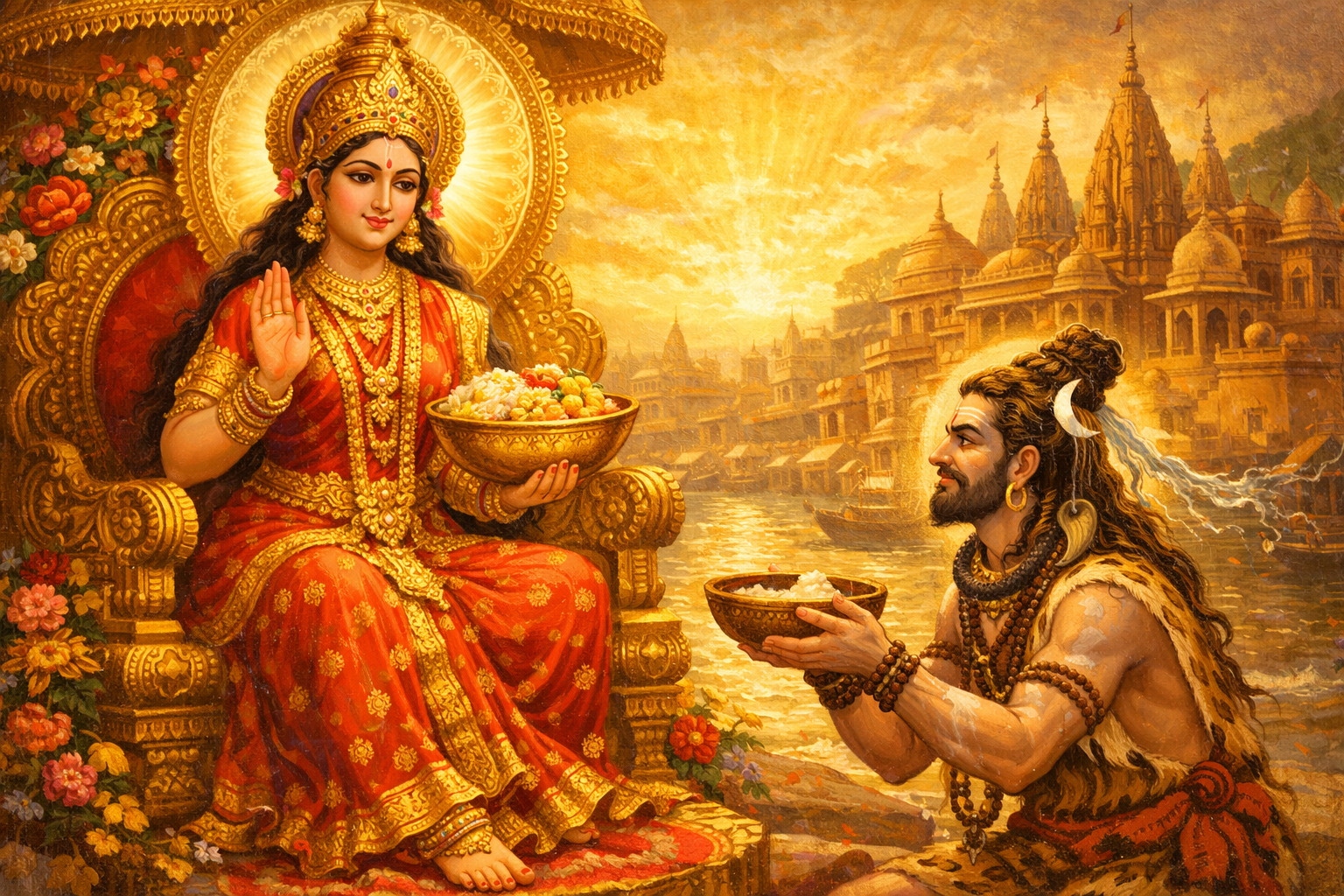
She was radiant, dressed in gleaming silks of red and gold. In her left hand, she carried a golden bowl that seemed to contain all the abundance of creation itself. In her right hand, she held a jewel-encrusted ladle that sparkled with promise. Her eyes held the warmth of a mother reunited with her children.
The people of Kashi, weak from hunger, could barely believe what they were seeing. But the aroma that wafted from her golden bowl—rich, nourishing, infused with every comfort they had ever known—told them this was no illusion.
“I am Annapurna,” the goddess announced, her voice like honey and rain and the laughter of children. “I am the giver of nourishment, the sustainer of life. Come, all who hunger. No one will be turned away.”
The Kitchen of Miracles
On the banks of the sacred Ganges, Annapurna established her kitchen. It was a simple structure, yet somehow vast enough to accommodate all who came. The divine fire that burned there never needed fuel, and the golden bowl never emptied no matter how much was served.
The first to arrive were the children, drawn by the irresistible aroma and the faint memory of what it felt like to have a full belly. Annapurna ladled out generous portions of fragrant porridge, rich with ghee and sweetened with jaggery. As the children ate, color returned to their cheeks and light to their eyes.
Then came the mothers and fathers, the elderly and the infirm, the wealthy who had lost everything and the poor who had never had anything. All were served equally from the goddess’s inexhaustible bowl.
But Annapurna offered more than just food. As people ate, they began to remember. They remembered the joy of sharing meals with loved ones. They remembered festivals and celebrations, weddings and births, all the occasions that food had made sacred. They remembered what it meant to be part of a community bound by the simple act of breaking bread together.
Slowly, miraculously, the world began to heal.
The Ganges swelled with fresh water. Fields that had been barren suddenly sprouted with green shoots. Trees that had stood dead and gray burst into bloom overnight. The Earth itself seemed to exhale in relief, welcoming back the divine energy that gave it life.
Word of Annapurna’s kitchen spread across the world like wildfire. People traveled for hundreds of miles to receive her blessing. The city of Kashi, already holy, became even more sacred—the place where the goddess herself had chosen to demonstrate the fundamental truth of existence.
That the material and spiritual were not opposites, but two faces of the same divine reality.
The Supreme God Bows
Among the throngs of pilgrims seeking Annapurna’s grace came a figure unlike any other.
He appeared as a wandering ascetic, dressed in nothing but ash and carrying a simple begging bowl. His hair was matted, his feet bare, his appearance utterly humble. To the casual observer, he might have been just another holy man seeking alms.
But those with spiritual sight recognized him immediately. This was no ordinary beggar—this was Lord Shiva himself, the supreme deity, stripped of all pretense and pride.
The crowd parted in awed silence as Shiva approached his wife.
He knelt before Annapurna, holding out his empty bowl with both hands. His head was bowed, his third eye closed, his infinite power set aside. In this moment, the destroyer of worlds was simply a hungry soul seeking sustenance and forgiveness.
“O Annapurna,” he said, his voice barely above a whisper, “I have been a fool. I dismissed as illusion the very foundation of existence. I belittled the sacred work of nurturing and sustaining life. I failed to see that consciousness without manifestation is as meaningless as a body without spirit. Please, grant this beggar your nourishment and your forgiveness.”
Annapurna looked down at her husband with eyes that held both sternness and infinite love. She raised her right hand in the abhaya mudra—the gesture of fearlessness and divine protection—offering assurance and safety.
Then, with her left hand, she filled Shiva’s bowl to overflowing with her golden porridge.
“Eat, my lord,” she said gently. “And understand that every mouthful is a prayer, every shared meal a communion, every act of nourishment a participation in the divine.”
Shiva ate, and in eating, he experienced something he had never fully understood before. The taste, the texture, the satisfaction of hunger sated—these were not merely physical phenomena. They were expressions of love made manifest, channels through which the divine became real and present in the world.
In Hindu iconography, Annapurna is often depicted with Lord Shiva as a beggar at her side. This powerful image reverses the usual hierarchy—the supreme god humbled before the goddess of nourishment. It teaches that even the highest spiritual knowledge is incomplete without honoring the material needs of life. Transcendence and nourishment are not enemies but partners in the sacred dance of existence.
The Sacred Truth Revealed
From that day forward, the story of Annapurna spread throughout the world, carrying with it a profound teaching.
The material world is not separate from the spiritual, nor inferior to it. The food we eat, the water we drink, the embrace of loved ones, the beauty of a sunset—these are not distractions from the divine. They are how the divine expresses itself in forms we can experience and share.
Annapurna’s kitchen in Kashi never closed. Generation after generation, devotees came to her temple to receive prasad—blessed food—and to remember the lesson she taught. That to feed the hungry is to serve the divine. That the act of sharing food is itself a sacred ritual. That the material comforts Parvati provides are not mere indulgences, but essential elements of a life lived in harmony with cosmic truth.
Even today, Annapurna is worshipped as the goddess of nourishment and abundance. Her image shows her holding the golden bowl and forming the gesture of protection, reminding all who see her that food is not just fuel for the body, but sustenance for the soul.
And sometimes, in her representations, you can still see Lord Shiva as the humble beggar, eternally receiving the lesson that even gods must learn:
That the material and spiritual are not enemies but partners in the dance of existence. That transcendence without compassion is empty. That the highest wisdom includes honoring the simple, sacred necessity of an empty bowl filled, a hungry child fed, a community gathered in gratitude around a shared meal.
This is the eternal teaching of Annapurna—that in nourishing the body, we nourish the soul, and in serving food with love, we serve the divine itself.
Explore More Sacred Stories
Subscribe to receive more fascinating stories from Hindu mythology and ancient wisdom traditions.
Discover the deeper meanings behind the gods and goddesses, the timeless lessons embedded in sacred texts, and how ancient wisdom applies to modern life.
Join our community of spiritual seekers and mythology enthusiasts!
Explore More Stories from Hindu Mythology:
- The Divine Feminine: Understanding Shakti in Hindu Philosophy
- Lord Shiva’s Greatest Lessons: Tales of Transformation
- The Power of Annapurna: How Food Connects Us to the Divine
- Sacred Temples of India: Where Mythology Meets Devotion
- The Meaning of Maya: Illusion and Reality in Hindu Thought
Reflect and Share: How does the story of Annapurna speak to you? What lessons about balance, humility, and the sacredness of daily life resonate with your own experience? Share your thoughts and reflections below!
The story of Annapurna continues to inspire millions of devotees who visit her temple in Varanasi (Kashi) and other sacred sites throughout India, where the tradition of feeding the hungry remains a central act of devotion.