
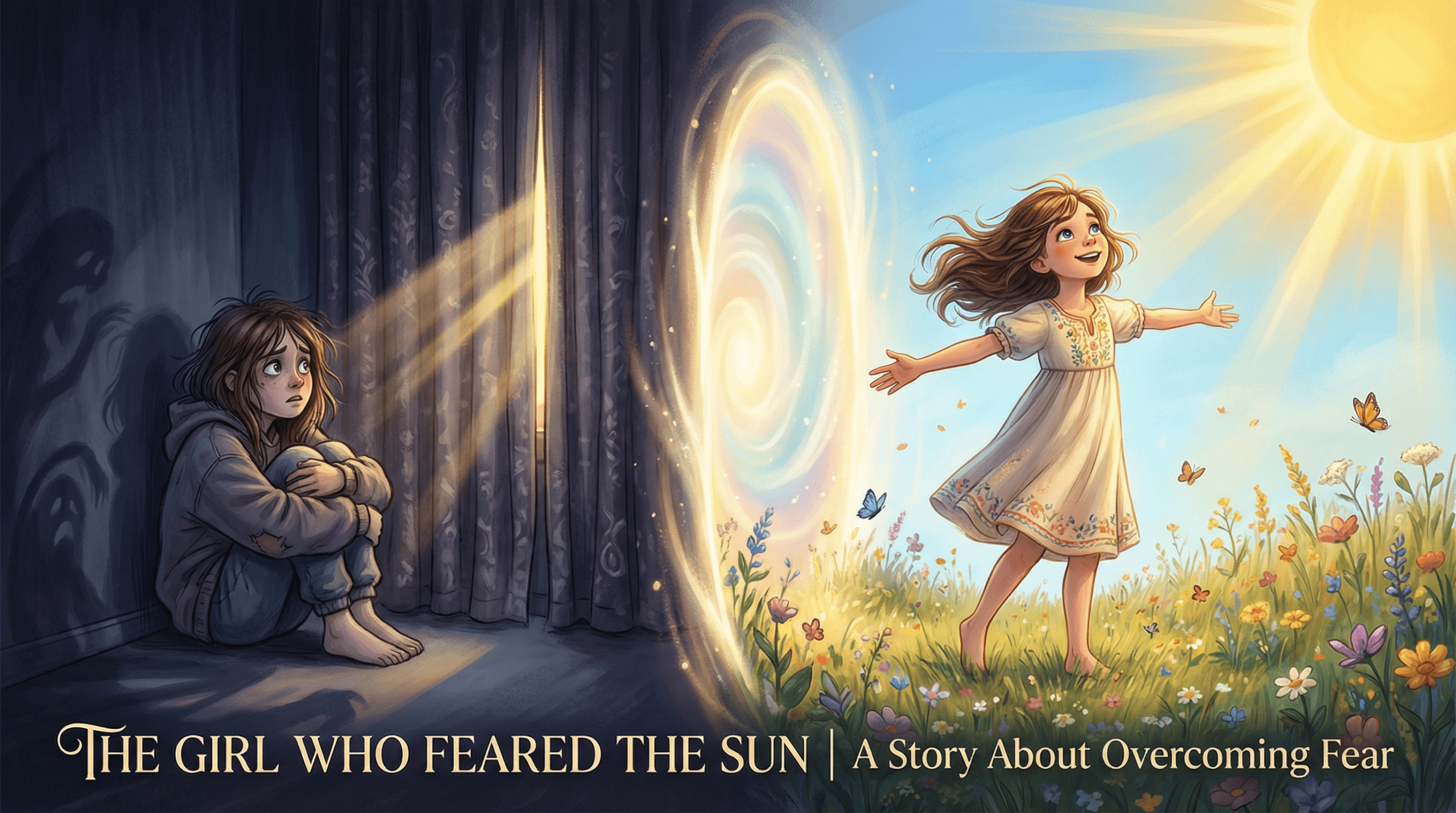
The Girl Who Feared the Sun
When fear becomes your identity, how do you learn to live in the light again?
Part One: The House of Whispers
Some fears are born from truth. Others grow from shadows until they become monsters all their own. Mine started with a sunny day and ended with discovering that the scariest things in life aren’t always what we think they are.
My name is Ava, and for most of my life, I believed the sun was trying to kill me.
I was born in a small town in Romania, the kind of place where everyone knows your business and nothing ever changes. Our house sat at the end of a winding road, surrounded by tall pines that blocked out most of the light. It was always dim inside, always cool, and to a child’s mind, always wrong.
My parents were strange. Not in the quirky, endearing way that makes for good stories—in the unsettling way that makes you question if you’re safe in your own home.
They never left the house. Not for work, not for groceries, not for anything. Every week, a large box of supplies would appear on our doorstep as if by magic. My father would bring it inside before dawn, and my mother would unpack it in silence while I watched from the stairs, trying to understand.
They spoke to each other in whispers. Constant, maddening whispers that would stop the moment I entered a room. Sometimes I’d catch fragments—words like “surveillance” and “target” and “cover”—but they meant nothing to my young mind. They only added to the growing conviction that something was deeply, terribly wrong.
My father spent hours each day hunched over newspapers, circling articles with a red marker, his face intense with concentration. My mother would pace the hallways at night, checking locks, peering through curtains at the empty road outside.
They barely looked at me.
When I was four years old, I learned that I was more of an inconvenience than a daughter.
It was breakfast time. I’d been asking my father to pour me cereal for ten minutes while he ignored me, his eyes fixed on his newspaper, his red marker moving in violent circles. Frustration bubbled up inside me—that hot, desperate need children have to be seen, to be acknowledged, to matter.
I climbed onto the table and stomped my foot directly into his cereal bowl.
Milk and cornflakes exploded across his carefully marked newspaper. The red ink began to run, bleeding into the soggy paper like wounds.
For one terrible second, my father’s face went blank. Then it twisted into something I’d never seen before—pure rage.
“Do you realize what you’ve done? You’re such a nuisance. Here—take the whole box. Just leave me alone, you idiot.”
He shoved the cereal box at me and returned to salvaging his ruined newspaper, muttering curses under his breath.
I took the box to my room and cried into my pillow, wishing I could disappear. Wishing I had different parents. Wishing I was someone else’s daughter—someone who would pour cereal with a smile and ask about my dreams.
Part Two: The Burning
We never had visitors. The isolation was suffocating. But when I was five, my grandmother came to see us, and for one bright afternoon, I thought things might be different.
She brought me a gift—a tiny orange kitten with white paws and the loudest purr I’d ever heard. I fell in love instantly, cradling the warm, vibrating bundle against my chest.
“No,” my mother’s voice cut through my joy like a knife. “We already have Ava. It’s hard enough taking care of her. Take it back.”
“Please,” I begged, tears already forming. “Please, I’ll take care of it, I promise—”
But my grandmother’s face had already fallen. She knew there was no arguing with my mother.
I ran to my room with the kitten and locked the door, certain that if I could just keep it hidden, everything would be okay. I made a bed for it in my closet using my softest sweater. I whispered promises that we’d be best friends forever.
When I woke up the next morning, the kitten was gone.
I tore my room apart looking for it. I searched every corner of the house, calling and calling, my voice growing hoarse. My parents claimed they knew nothing about it, but I saw the truth in their averted eyes, in the way my mother’s hand trembled slightly as she stirred her coffee.
They’d gotten rid of it. Thrown away the only thing that had ever loved me back.
Something inside me broke that day. Something that whispered: They don’t want you. They’ve never wanted you.
Before my parents could stop me, I bolted out the front door into the bright morning sun.
It was a beautiful day. The sky was impossibly blue, the sun brilliant and warm. I ran down our road, tears streaming down my face, with no plan except to get away, to be anywhere but that house of whispers and rejection.
I made it maybe fifty yards before my skin began to tingle.
At first, it was just warmth. Then heat. Then burning.
I looked down at my arms and watched in horror as they turned bright red, as if I’d been scalded. The tingling became itching. The itching became fire. I looked up at the sun—that golden orb I’d played under a hundred times before—and suddenly it felt like a spotlight revealing every vulnerability, every weakness.
My skin began to blister.
I screamed. The sound that came out of me wasn’t human—it was pure animal terror. My vision went white at the edges. The last thing I remember was my knees hitting the gravel road, and then nothing.
“The doctor came. You’re fine. Just a bad sunburn. You were out there too long.”
“I’m not fine. The sun tried to kill me.”
“Ava, don’t be dramatic. It was just—”
“The doctor is wrong. You’re wrong. Something’s wrong with me, and you don’t even care.”
My mother opened her mouth to argue, then seemed to think better of it. She left without another word, closing the door softly behind me.
I lay there in the darkness, my skin still tingling with phantom pain, and made a decision: I would never let the sun touch me again.
Part Three: The Ninja
If my parents thought I was strange before, they were unprepared for what came next.
I became a ghost in my own home—a figure wrapped head to toe in protective layers. Long sleeves under hoodies. Pants tucked into thick socks. Gloves. A face mask covering everything but my eyes. I looked like a tiny ninja or a very paranoid burglar.
I refused to go near windows during the day. If a curtain was open even a crack, I’d scream until someone closed it. I’d only remove my protective clothing after sunset, emerging from my cocoon like some strange nocturnal creature.
My parents were horrified. They tried reasoning with me, then pleading, then ignoring me in hopes I’d give up. But the fear had taken root too deeply. Every time I thought about the sun, I could feel that burning again, could see my skin turning red and angry.
The fear became my identity. And in a house where I felt invisible, at least this made me seen.
The years passed in twilight. I was homeschooled, rarely leaving the house, living more and more in my imagination where the world outside couldn’t hurt me. My parents’ whispers continued. Their strange behavior persisted. And I retreated further into my shell, convinced that they were somehow responsible for my condition, that they wanted me to suffer.
Then, when I turned thirteen, my mother made an announcement that shattered my carefully constructed world.
“You’re going to regular school next year. We’re done homeschooling you.”
“What? No. I can’t—the sun—”
“There’s nothing wrong with you, Ava. This has gone on long enough. You’re going to school, and that’s final.”
“You want me to die. You’ve always wanted me to die.”
My father’s face darkened. “If you keep this up, we’ll send you to your aunt in Norway. They have sunlight for six months straight there. Is that what you want?”
The threat hung in the air between us. Norway. Six months of endless sun. It would be torture. It would be death.
“Fine. I’ll go to school. But I’m wearing this. And when everyone thinks you’re terrible parents for making your daughter dress like this, remember that you asked for it.”
Part Four: The Vampire Girl
Walking into eighth grade dressed like I was preparing for a biohazard situation was exactly as awful as I’d imagined.
The laughter started before I even reached my classroom. Whispers followed me down the hallway like a swarm of bees. I heard the words clearly: “Weirdo.” “Freak.” “What is she wearing?”
I kept my eyes straight ahead and found an empty seat by the window—ironically, since I immediately pulled the curtain closed, plunging my corner of the room into shadow.
During lunch, everyone fled to the cafeteria except me. And one other girl.
She had perfect blonde hair, designer clothes, and the kind of confidence that comes from never having been told “no” in your entire life. She approached my desk with a smile that didn’t reach her eyes.
“Ava, right? I’m Jesse. I’m just curious—why are you dressed like a garbage bag?”
“I’m allergic to the sun. It burns my skin.”
Jesse’s laugh was sharp and bright. “Sure it does.” She walked away, still laughing, and I knew immediately that she was going to make my life hell.
I was right.
Jesse was the queen of the school, and she made it her personal mission to break me. She put whoopee cushions on my seat. She “accidentally” spilled water where I’d walk, making me slip and fall. She mocked everything about me—my clothes, my condition, my existence.
I endured it all with gritted teeth, refusing to give her the satisfaction of seeing me cry.
Then one day, she went too far.
I was standing in the shade during a baseball game, actually enjoying myself for once, when Jesse appeared beside me. Before I could react, she grabbed my arm and yanked me into direct sunlight.
“Let’s see this allergy of yours!” she laughed, reaching for my hoodie.
Panic flooded my system. The same panic from that day when I was five. I could already feel the burning starting, could see my skin beginning to redden—
I bit her hand. Hard. Hard enough to taste copper.
Jesse screamed and released me. I ran, my heart hammering, back to the safety of shadows.
“You crazy freak! You’re not allergic to the sun—you’re a vampire! Vampire girl! That’s what you are—a monster!”
The name stuck. Vampire Girl. People said it in whispers, in taunts, in jokes I wasn’t meant to hear. But strangely, I didn’t hate it. Being a monster was better than being a victim. At least monsters were feared. At least monsters had power.
Part Five: The Janitor’s Son
Nick arrived on a Tuesday, wearing clothes that had been washed so many times they’d faded to ghosts of their original colors. His shoes had holes. His backpack was held together with duct tape.
I watched Jesse and her friends circle him like sharks smelling blood, their laughter already beginning.
At lunch, I found him sitting alone, poking at a sad-looking sandwich.
“Mind if I sit?” I asked.
He looked up, surprised. “You’re the… uh, you’re Ava, right? Vampire girl?”
“That’s what they call me. You’re Nick. The janitor’s son.”
He flinched. “Yeah. That’s me.”
We ate in comfortable silence for a while. Then Nick said, “Can I ask you something? Are you really allergic to the sun?”
“Yes. It burns me. Makes my skin blister.”
He didn’t laugh. Didn’t call me crazy. Just nodded. “That must be hard.”
Something in my chest loosened. “Yeah. It is.”
We became friends after that—two outcasts who understood what it meant to be different, to be judged, to be alone. For the first time since leaving Romania, I felt like maybe I wasn’t quite so invisible after all.
But Jesse couldn’t stand to see anyone happy if she wasn’t the center of attention.
One day, I found her and her minions surrounding Nick in the hallway. She’d spilled juice on the floor in front of him.
“Oops. Guess you’d better clean this up, Nick. I mean, you’ll grow up to be a janitor like your dad, right? Might as well practice now. Just sit down and wipe it with your butt.”
Something red and hot flooded my vision. Before I could think, I was there, putting myself between Nick and Jesse.
“Remember the last time you messed with me? I bit you. And I’ve been thinking about biting harder next time. So back. Off.”
For a second, Jesse looked uncertain. Then I took a step forward, and she actually stumbled backward.
“Stay away from him. Or I’ll show you what a real vampire can do.”
Jesse and her friends scattered. Nick stared at me with something like awe.
“You didn’t have to do that.”
“Yes, I did. That’s what friends do.”
Part Six: The Thief
The scream echoed through the classroom, sharp enough to shatter glass.
“My phone! Someone stole my brand new iPhone!”
Jesse’s eyes swept the room like searchlights, then locked onto Nick with the certainty of someone who’s already decided on a verdict.
“You. You took it. I know you did, you little thief.”
“I didn’t—” Nick’s face had gone pale. “I swear, I didn’t touch your phone—”
“Liar! Where is it?”
I pushed between them. “Back off, Jesse. You have zero proof.”
“Oh, I’ll get proof.” Jesse grabbed Nick’s backpack and upended it. Books, papers, pencils scattered across the floor. Nothing.
We got into a screaming match that ended with both of us in the principal’s office. Jesse insisted they search Nick’s locker. They did. Found nothing.
But the damage was done. Everyone had seen Jesse accuse him. Everyone had watched him defend himself. And in a school where your reputation is everything, being called a thief—even without proof—is a death sentence.
Nick was silent all day. When I caught up with him after school, his eyes were red.
“Hey, are you okay?”
“Do I look okay? Rich people like Jesse—they think we’re all criminals just because we’re poor. She called me a thief in front of everyone, and even though they didn’t find anything, that’s what they’ll remember.”
“Nick—”
“I hate them, Ava. I hate all of them. I hate this whole stupid school.”
He walked away before I could say anything else, his shoulders hunched against a world that had never been fair to him.
He didn’t come to school the next day. Or the day after that. A week passed with no sign of him or his father.
I started to worry. I remembered Nick mentioning that his dad worked at a restaurant in the evenings, so I decided to go looking for him there.
It was a Thursday night when I finally ventured out without my usual armor. The sun had set hours ago, and I felt almost normal walking down the street in just jeans and a t-shirt, my face bare to the cool evening air.
I was two blocks from the restaurant when I saw someone running toward me.
A figure in a ski mask. Moving fast. Too fast to be just a jogger.
He grabbed my bag, yanking hard. I held on instinctively, shouting, “Let go!”
We struggled. In the chaos, I grabbed the edge of his mask and pulled.
The mask came off.
Nick’s face stared back at me, frozen in horror.
For a moment, we both just stood there. Then he turned and ran, my bag forgotten on the ground.
I stood in the empty street, my heart hammering, trying to make sense of what I’d just seen. Nick. My friend Nick. The boy who’d been so angry about being called a thief.
He actually was one.
Part Seven: The Truth
Nick came back to school two days later, but I couldn’t look at him. Every time he tried to approach me, I turned away. The betrayal sat in my chest like a stone.
Finally, he cornered me after class.
“Ava, please, can we talk?”
“I don’t have anything to say to you.”
“Then just listen—”
“Listen to what? More lies? Jesse was right about you all along. You’re a thief.”
His face crumpled. “That was you? The girl I—oh god, I didn’t know. I’ve never seen your face, I didn’t realize—”
“It doesn’t matter who it was! What matters is that you lied to me. I defended you. I fought for you. And you were stealing from people all along.”
“No! No, I swear, I never stole anything before that night. I didn’t steal Jesse’s phone. I’m not a thief, Ava. I’m not.”
“Then why—”
“My dad’s in the hospital. He collapsed at work last week. Heart problems. They did emergency surgery, but we can’t pay for it. We have nothing. And he kept saying how sorry he was, how he’d failed me, and I just—I couldn’t take it anymore.”
He was sobbing now, the kind of desperate crying that comes from carrying too much alone for too long.
My anger evaporated. I pulled him into a hug while he cried into my shoulder.
“I’m sorry about your dad. But Nick, stealing isn’t the answer. You should have told me. I would have helped.”
“I was too ashamed. I didn’t want you to know how bad things were.”
“I’m your friend. That means you tell me when things are bad. And we figure it out together.”
The biggest donors? Jesse’s parents.
They were at the fundraiser, smiling and shaking hands, acting like they were saving the world one charitable donation at a time. They kept praising me for “taking initiative” and “showing real leadership.”
Part Eight: The Unmasking
Jesse stood beside her parents at the fundraiser, her face twisted with barely concealed rage.
“Don’t let it get to your head, freak. You’re still a vampire weirdo, and you’ll never be anything like me.”
I smiled sweetly. “You’re right. I’d hate to be anything like you. What’s so special about you anyway, other than being really good at being mean?”
“Excuse me? I’ve been prom queen for the last two years. You could never.”
“Is that so? Well, maybe this year will be different.”
“This is a prom, not a freak show. You’ll never win against me, loser.”
Nick leaned over and whispered, “She’s never even seen your face. That’s your secret weapon.”
A plan began forming in my mind. A small, rebellious plan that made me smile for the first time in days.
I bought a red dress for prom. Deep crimson, like blood in candlelight. It was the most beautiful thing I’d ever owned, and since prom was at night, I’d finally be able to go somewhere without my protective clothing.
The night of the dance, I stood in front of my mirror, barely recognizing the girl staring back. Without the hoodie and mask, I could see myself clearly for the first time in years. Dark hair falling past my shoulders. Pale skin that looked almost luminous in the low light. Eyes that seemed larger without half my face covered.
I looked like a stranger. I looked like me.
When I walked into the decorated gymnasium, conversations stopped mid-sentence. Heads turned. People whispered behind their hands.
“Who is that?”
“Is that a new student?”
“She’s gorgeous.”
Nick found me in the crowd and took my arm. “Ava. You look amazing.”
“That’s Ava? The vampire girl?”
“I can’t believe that face was hidden this whole time!”
The whispers spread like wildfire. I watched recognition dawn on face after face, watched surprise turn to admiration.
Jesse’s face, when she saw me, was the color of a ripe tomato.
The voting for prom queen happened an hour into the dance. When they announced the results, my name echoed through the gymnasium speakers.
“This year’s prom queen is… Ava Petrescu!”
The crown was placed on my head, and for one perfect moment, I felt like I belonged.
Then Jesse came charging across the dance floor. She lunged for the crown, screaming, her hands clawing at my head.
But a wall of students stepped between us. They held Jesse back as she screamed and struggled.
“Don’t touch our prom queen!”
Part Nine: The Final Test
The weeks after prom were the best of my school life. People actually talked to me. Smiled at me in the hallways. Even some of Jesse’s former friends had abandoned her after her meltdown.
Jesse and her remaining minions glared at me constantly, but they kept their distance. I thought maybe I’d finally won.
I should have known better.
It was after gym class on a Wednesday. I’d been changing quickly in the corner of the locker room, trying to get my protective clothing back on before anyone could really see me. Most of the other girls had already left.
Then the door burst open.
Jesse and three of her friends rushed in. Before I could react, one of them grabbed my hoodie from my hands while the others seized my arms and legs.
“What are you—no! Stop!”
They carried me toward the door. I thrashed and kicked, screaming, but they were determined.
“Let’s see what happens to the vampire girl in real sunlight. Maybe you’ll melt. Maybe you’ll burst into flames. Either way, this is for stealing my limelight.”
They kicked open the exterior door. Bright afternoon sunlight poured in, blinding after the dimness of the locker room. I squeezed my eyes shut, already anticipating the burning, the pain, the blistering—
They threw me down on the concrete outside.
I waited for the agony to start. Waited for my skin to turn red, for the fire to consume me.
Nothing happened.
“What’s going on here?” A teacher’s voice, sharp with authority.
Someone pulled me to my feet—gentle hands, worried voice. Nick.
“Are you okay? Does it hurt?”
I opened my eyes slowly. The sun was bright, yes. Warm. But not burning. I looked down at my exposed arms, my bare shoulders where my gym shirt revealed skin.
They were fine. Completely, utterly fine. Not even a hint of redness.
“I… I don’t understand.”
Nick stared at me. “Ava, you’re in direct sunlight. You have been for almost a minute. And you’re okay.”
I touched my arms, half expecting them to be hot or tender. They weren’t. They felt normal. I looked up at the sky—that terrifying orb I’d feared for so long—and felt only warmth.
No pain. No burning. No blistering.
Had it all been in my head? Eight years of fear, of hiding, of covering myself—had it all been based on nothing?
Part Ten: The Truth About Fear
I walked home that day with my face exposed to the sun for the first time in years. Every step felt like a small rebellion against my own mind. The warmth on my skin was pleasant. Normal. How had I forgotten what this felt like?
When I arrived home, my parents were in the kitchen. They looked up at me, and their faces went white.
“Ava… where’s your hoodie? Your mask?”
“I was out in the sun today. For a long time. And nothing happened to me. Nothing at all.”
They exchanged a look. Then my mother started crying. My father pulled her close, and they both looked at me with expressions I’d never seen before. Regret. Relief. Love.
“Sweetheart, we tried to tell you. For years, we tried. It wasn’t real. You got a bad sunburn when you were little, and it scared you so much that you convinced yourself it would happen again. But it was just a normal sunburn. You’re not allergic to the sun. You never were.”
The words hit me like a physical blow. “But… no. I felt it. That day I ran away, my skin was burning—”
“Panic attack. Your fear was so strong that your mind created the symptoms. We had doctors examine you. Therapists. Everyone said the same thing—there was nothing physically wrong with you. It was psychological.”
I sank into a chair. “All this time… I’ve been afraid of nothing?”
“Not nothing. Fear is real, even when the danger isn’t. And we failed you, Ava. We should have done more to help you overcome it.”
“Why didn’t you tell me about the doctors? About the therapists?”
“Because we were distracted. Distant. We had our own problems, and we let you down when you needed us most.”
“What problems?”
My mother took a deep breath. “Your father and I worked as undercover government agents. We were investigating a criminal organization operating in our region. For years, we had to maintain absolute secrecy. We couldn’t leave the house during certain hours. Couldn’t have visitors. Couldn’t explain anything to you because keeping you in the dark kept you safe.”
I stared at them, my mouth open. “You’re… spies?”
“Were. We retired last year. The case is closed. But during those years when you were growing up, when you needed us most, we were consumed by that work.”
Suddenly, so many things made sense. The secrecy. The isolation. Their strange behavior that I’d interpreted as not caring about me.
“We should have told you sooner. We should have made you feel safe and loved instead of leaving you to create your own explanations for our behavior. I’m so sorry, Ava. We love you so much.”
Something that had been tight in my chest for eight years suddenly loosened.
“I love you too.”
We held each other in the fading afternoon light, the sun streaming through the windows that had been closed for so long. And for the first time in years, I felt like we might actually be a family.
What Did You Think of Ava’s Journey?
This story explores how childhood trauma, family secrets, and the power of fear can shape our entire lives—and how courage means facing what terrifies us most.
Have you ever been paralyzed by a fear that turned out to be less dangerous than you thought? How did Ava’s story resonate with you? Share your thoughts below!