
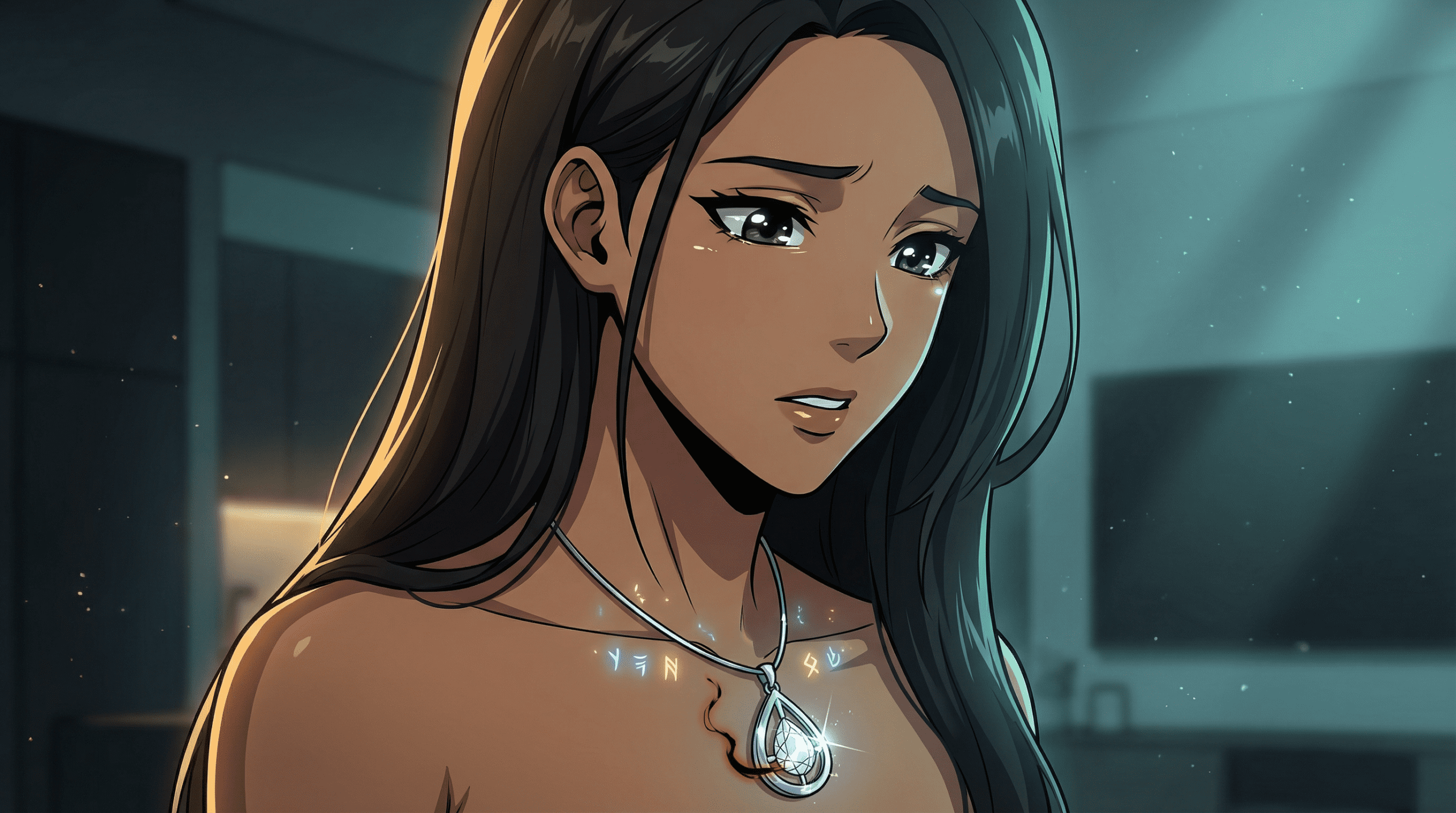
The Necklace That Changed Everything
Some gifts come with prices we can’t see until it’s too late to pay them back.
Chapter One: Invisible
My name is Helen, and for most of my seventeen years, I’ve been invisible.
Not literally—I’m not some ghost haunting the hallways of Riverside High. But I might as well have been. I was the girl people’s eyes slid past without registering. The one who sat in the back row, hoodie up, earbuds in, hoping to make it through another day without anyone noticing I existed.
It wasn’t always terrible. Being invisible had its advantages. No one expected anything from me. No one judged me. I could disappear into my books and my music and my own little world.
But sometimes—most times—I wanted to be seen.
My sister Lucy never had that problem.
Lucy was a year younger than me but light-years ahead in every way that seemed to matter. She had the kind of natural beauty that made people do double-takes in the grocery store. Straight A’s in all AP classes. Captain of the debate team and the basketball team. The kind of girl who made everything look effortless.
I loved my sister. I really did. We’d grown up sharing a room, sharing secrets, being each other’s best friend when the world felt too big and scary. But somewhere around middle school, our paths had diverged. Lucy had bloomed into this confident, brilliant person everyone wanted to be around.
And I’d stayed exactly the same.
“You know Mom and Dad don’t love you less, right?” Lucy had said to me once, catching me staring at the wall of photos in our living room—ninety percent Lucy’s achievements, ten percent obligatory family pictures that happened to include me.
“I know,” I’d lied.
The truth was more complicated. Our parents didn’t favor Lucy on purpose. They just… noticed her more. It was hard not to. She sparkled. I faded into the background.
I told myself I was okay with it. That I didn’t need attention or popularity or any of that shallow high school drama.
But deep down, in the quiet hours of the night when I couldn’t sleep, I wished—desperately, achingly—that someone would look at me the way people looked at Lucy. Like I mattered. Like I was worth seeing.
I should have been more careful about what I wished for.
Chapter Two: The Package
It arrived on a Tuesday morning in late September.
I was halfway through brushing my hair, trying to tame the mess of brown waves that never seemed to cooperate, when the doorbell rang. Through my bedroom window, I could see our front porch. No car in the driveway. No delivery truck on the street.
Weird.
I thundered down the stairs, beating Lucy to the door by seconds. On the porch sat a small package wrapped in silver paper that caught the early morning light like liquid mercury. My name was written across the top in perfect calligraphy: Helen.
Not “Helen Matthews.” Not “To the Matthews residence.” Just my first name, written with such precision it looked like art.
“Secret admirer?” Lucy teased, peering over my shoulder.
“Right. Because I have so many of those.”
I brought the package inside and opened it at the kitchen table while Lucy made toast. Inside the silver wrapping was a velvet pouch, dark purple and impossibly soft. The kind of packaging you see in movies when someone’s about to propose with a ring that costs more than a car.
My hands trembled slightly as I loosened the drawstring.
The necklace that spilled into my palm was breathtaking. A delicate silver chain held a pendant shaped like a teardrop, with what looked like a real diamond at its center. The gem caught the kitchen light and threw tiny rainbows across the ceiling.
“Holy crap,” Lucy breathed, abandoning her toast to get a closer look. “That’s gorgeous. Who sent it?”
I unfolded the note that had been tucked beneath the necklace. The same perfect handwriting, this time on cream-colored cardstock:
“For as long as you wear this necklace, true love will find you.”
“Okay, that’s either really romantic or really creepy,” Lucy said. “No return address?”
I turned the box over. Nothing. No shipping label, no postmark, no indication of where it had come from or who had sent it.
“Maybe it’s from Alan,” Lucy suggested, wiggling her eyebrows.
My face heated. Alan Carter had been my crush since eighth grade—quiet, artistic, the kind of boy who wore vintage band t-shirts and actually read the books assigned in English class. We’d been lab partners once in freshman year, and he’d smiled at me, and I’d been pathetically gone ever since.
But Alan didn’t know I existed. Not really.
“It’s not from Alan,” I said firmly.
“Well, whoever sent it has good taste. You should wear it.”
I looked down at the necklace, still pooled in my palm. The diamond seemed to pulse with inner light, hypnotic and beautiful.
What could it hurt?
I fastened the chain around my neck. It settled against my throat with surprising weight—not uncomfortable, but present. Claiming. Like it was marking its territory.
Lucy studied me with her head tilted. “You know what? It actually looks really good on you. Brings out your eyes.”
I glanced at my reflection in the toaster. The necklace did look good. It looked expensive. It looked like something a girl who mattered would wear.
I smiled.
The necklace seemed to warm against my skin, and for just a second, I could have sworn I felt it tighten—just a fraction, just enough to notice.
Then the moment passed, and I was just Helen again. Invisible, forgettable Helen.
Except this time, I had a beautiful necklace.
I had no idea what I’d just invited into my life.
Chapter Three: The Shift
The change started immediately, though it took me a while to notice.
I walked into school that morning the same way I always did—head down, earbuds in, trying to make myself as small as possible in the crowded hallways. But something was different.
People were looking at me.
Not just glancing in my direction or accidentally making eye contact before looking away. Actually looking. Seeing me.
A junior I’d never spoken to smiled and waved as I passed. Two freshman girls whispered to each other, their eyes tracking me with something that looked almost like admiration. A guy from my calculus class—someone who’d sat three seats away from me for two months without acknowledging my existence—called out a greeting.
“Hey, Helen! Love the necklace!”
I touched the pendant self-consciously. “Thanks?”
At my locker, I found Jessica Park and Dana Chen waiting for me. Jessica and Dana were the undisputed queens of Riverside High’s social hierarchy—beautiful, confident, the kind of girls who threw parties in mansions and dated college guys. In three years of attending the same school, they’d never said more than five words to me.
Now Jessica was beaming at me like we were long-lost best friends.
“Helen! Oh my god, you look so cute today!”
Dana nodded enthusiastically. “Right? I was just saying that. Helen, you should totally sit with us at lunch.”
I blinked at them, waiting for the punchline. Was this a prank? Some elaborate setup to humiliate me?
But Jessica just kept smiling, and Dana looped her arm through mine like we’d been friends forever.
“We’ll save you a spot,” Jessica said, squeezing my hand. “Don’t be late!”
They glided away in a cloud of expensive perfume, leaving me standing at my locker in stunned silence.
What the hell was happening?
In biology, Mr. Smith—who’d never said anything about my work beyond a few checkmarks and the occasional “see me after class” when I’d bombed a quiz—held up my homework as an example.
“Everyone should take notes from Helen’s lab report. This is exactly the kind of thorough, thoughtful analysis I’m looking for.”
Twenty-five pairs of eyes turned to stare at me. I shrank in my seat, but the attention didn’t feel hostile. It felt… curious. Interested.
By lunch, I’d been complimented six more times, added to three group texts, and invited to two parties happening that weekend.
I sat with Jessica and Dana and their crowd—people I’d observed from a distance for years like they were a different species. They welcomed me into their conversation, laughed at my jokes, asked my opinion on everything from the cafeteria’s mystery meat to the drama with some senior couple I’d never heard of.
It was intoxicating.
For the first time in my life, I felt like I mattered. Like I existed in color instead of grayscale.
Only one person didn’t seem affected by whatever transformation I’d undergone.
Alan Carter walked past our table without so much as a glance in my direction, his messenger bag slung over one shoulder, headphones covering his ears. The same way he’d walked past me every day for three years.
I watched him disappear into the lunch line, and something cold twisted in my chest.
Everyone else suddenly noticed me. Why couldn’t he?
The necklace didn’t make people like me. It made people need me. It created an artificial gravitational pull that drew others into my orbit whether they wanted to be there or not.
But some people—people with strong enough wills, people who didn’t care about social hierarchies—could resist it.
Alan was one of those people.
And my inability to affect him would become an obsession.
That night, my phone wouldn’t stop buzzing. Friend requests, follower notifications, text messages from numbers I didn’t recognize. My Instagram gained three hundred followers in six hours.
Lucy found me staring at my phone in disbelief.
“So you’re famous now?” she teased, flopping onto my bed.
“I don’t understand what’s happening,” I admitted. “It’s like I woke up in a different universe.”
Lucy reached over and touched the necklace, which I’d completely forgotten I was still wearing. “Maybe it’s magic.”
We both laughed, but there was a flutter of unease in my stomach.
“Whatever it is,” Lucy said, settling back against my pillows, “enjoy it. You deserve to have people pay attention to you for once. Maybe I’ll have some competition now.”
“Competition?”
“For being the star sister.” She grinned. “Guess we’re a dream team now.”
I smiled back, but something about her words stuck with me.
Competition.
For the first time in our lives, Lucy and I were on equal footing. Maybe—if this continued—I might even surpass her.
The thought should have felt triumphant. Instead, it felt dark. Hungry.
I touched the necklace again, and I swear I felt it pulse against my fingers.
Warm. Alive. Waiting.
Chapter Four: The Corruption Begins
Over the next week, my transformation from invisible to invincible accelerated.
People sought my approval for everything. What to wear, who to date, which parties to attend. Jessica and Dana started deferring to me in conversations, asking my opinion first, watching my reactions to gauge their own.
Boys who’d never looked at me twice suddenly found excuses to talk to me. Senior guys. College guys who hung around the parking lot after school. One of them—a lacrosse player named Brett who’d dated half the cheerleading squad—cornered me at my locker.
“Helen, right? I used to have a thing for your sister, but…” He gave me a slow, appreciative smile. “Damn. Where have you been hiding?”
Old Helen would have stammered and blushed and made an excuse to leave. New Helen looked him up and down with cool assessment.
“Why would I be interested in you when I could have literally anyone in this school? Guys who are, what’s the phrase… double your worth?”
Brett’s confident smile faltered. Behind him, Jessica and Dana burst into laughter.
“Ohhh, she got you good!”
Brett slunk away, and I felt a rush of power that was better than any drug.
I could say anything. Do anything. And people would either worship me or get out of my way.
But there was still one person who remained frustratingly immune to my newfound influence.
Alan.
I saw him in the hallway one morning, standing at his locker with that perpetually thoughtful expression, probably thinking about art or music or whatever occupied his mind.
I walked past him deliberately, close enough that he’d have to notice me, and flipped my hair over my shoulder in what I hoped was a casually alluring gesture.
“Hey, Alan. Nice shirt.”
He glanced up, momentarily confused, like he couldn’t quite place why I was talking to him. “Oh. Uh, thanks?”
Then he went back to his locker.
That was it. No lingering stare. No stumbling over his words. No visible reaction to the fact that I’d spoken to him.
Nothing.
Fury bloomed in my chest, hot and sharp. How dare he dismiss me? How dare he look at me like I was still nobody?
I wanted to grab him by the shoulders and shake him. Make him see me. Make him kneel.
The violence of my own thoughts shocked me. I wasn’t a violent person. I’d never hurt anyone in my life.
But the necklace pulsed warm against my throat, and the anger felt righteous. Justified.
“Trouble in paradise?”
The voice came from behind me—deep, accented, unfamiliar. I turned.
Edward Castellano leaned against the wall, arms crossed, watching me with dark, amused eyes. He’d transferred to Riverside two months ago from somewhere in Europe—Italy, I’d heard, or maybe France. He was beautiful in an almost uncomfortable way: tall, perfectly styled dark hair, the kind of bone structure that belonged on magazine covers.
He also had a reputation for being untouchable. Rich family, expensive cars, private life. He didn’t interact with the student body beyond what was absolutely necessary.
So why was he talking to me?
“Who dares make our queen angry?” he continued, his slight accent making the words sound like poetry.
I raised an eyebrow. “Queen?”
“You have not noticed? Everyone watches you now. Everyone wants to please you.” He pushed off the wall and moved closer. “Everyone except him, yes?”
He nodded toward Alan’s retreating back.
I should have been embarrassed that my frustration was so obvious. Instead, I found myself intrigued.
“You always show up when someone’s having a breakdown?”
“Only when it’s interesting.”
Before I could respond, Coach Williams blew his whistle, signaling the start of gym class. Edward and I ended up paired together for the relay course—hurdles, tire runs, rope climbs. The kind of physical torture that usually left me sweaty and humiliated.
But today was different. Today I felt strong. Powerful. I sailed over the hurdles like I’d been training for the Olympics, beat Edward to the rope wall, landed every tire jump with perfect precision.
He kept pace with me, and I could feel his eyes on me the whole time.
“You do this often?” he asked as we army-crawled under the cargo net. “Pretend gym class is a runway?”
“Only when I have an audience worth impressing.”
We crossed the finish line together, both breathing hard. Edward looked at me with something between admiration and hunger.
“You’re the most beautiful girl I have ever seen,” he said simply. “Let me take you out.”
It wasn’t a question. It was a statement of fact, delivered with the confidence of someone who’d never been told no.
I should have been suspicious. I should have wondered why someone like Edward—rich, gorgeous, mysterious—was suddenly interested in me.
But the necklace hummed approval against my skin, and all I could think was: Finally. Someone who matches my new status.
“Pick me up at seven,” I said.
Edward smiled.
And I had no idea I’d just made a deal with the devil.
Chapter Five: The Golden Cage
Dating Edward was like being upgraded to first class on a flight I hadn’t known I’d booked.
Every morning, there was a single rose waiting at my locker with a note in that same perfect handwriting: “For my beautiful Helen. Thinking of you always. —E.”
He waited outside my classrooms to walk me to the next one. He carried my books. He paid for my lunch before I could even reach for my wallet. The gestures were old-fashioned, romantic, and utterly intoxicating.
But it was the luxury that really changed things.
Edward came from wealth I couldn’t even comprehend. Swiss chocolates that cost more than my weekly grocery budget. Designer clothes casually gifted like they were nothing. Dinners at restaurants I’d only seen in magazines. Cars with doors that opened themselves and seats that warmed at the touch of a button.
I stopped being “Helen from Riverside High” and became “Helen, Edward Castellano’s girlfriend.”
And that title carried weight.
People treated me differently. Teachers let things slide that they would have written up other students for. The principal knew my name. Even the seniors—the ones who usually barely acknowledged underclassmen existed—gave me space and respect.
I was untouchable.
But there were cracks in the facade, even if I refused to see them.
Edward and I didn’t really talk. Not about anything real. He’d compliment me, tell me I was beautiful, plan elaborate dates. But when I’d try to learn about him—his family, his childhood, what he wanted to do after graduation—his answers were always vague. Deflecting.
“The past is boring,” he’d say with that charming smile. “I only care about the present. About us.”
He never got my jokes. When I’d reference a movie or a song I loved, he’d just smile politely and change the subject. We had no shared interests, no real connection beyond the surface.
But he looked perfect next to me. And in my new life, appearances were everything.
It happened three weeks into dating Edward. Mr. Smith caught me cheating on a biology test—blatantly, obviously, because I’d stopped caring about consequences.
When he tried to send me to the principal’s office, I laughed in his face. Edward stood up and actually pushed our teacher, a man in his fifties, hard enough to make him stumble.
The class gasped. Mr. Smith went pale.
And I felt thrilled.
Edward walked out with me, arm around my shoulders, and somehow—through money or threats or magic, I never found out—the incident disappeared. No detention. No call home. Nothing.
I should have been horrified. Instead, I felt invincible.
Meanwhile, Lucy was pulling away from me.
At first, it was subtle. She’d spend more time in her own room. Make excuses not to hang out. Stop asking about my day.
Then one night, she confronted me.
“Helen, you need to stop seeing Edward.”
I looked up from my phone, where I’d been scrolling through comments on a photo Edward had posted of us. Two thousand likes in an hour.
“Why? Jealous?”
The word came out sharper than I’d intended, but I didn’t take it back.
Lucy’s expression flickered with hurt. “This isn’t about jealousy. You’re changing, Helen. That necklace, Edward, all of it—it’s changing you into someone I don’t recognize.”
“You mean someone who actually matters? Someone people pay attention to?”
“I mean someone cruel.” Lucy’s voice cracked. “You used to be kind. You used to care about people. Now you treat everyone like they’re beneath you.”
“Maybe they are.”
The words hung in the air between us, ugly and true.
Lucy stared at me like I’d slapped her. “I don’t chase after you or worship you because I’m your sister. I loved you before any of this started. But that necklace is poisoning you, and you’re too blind to see it.”
“Or maybe I finally see clearly for the first time in my life.” I stood up, and Lucy actually took a step back. “You’ve been the special one our whole lives. The smart one, the pretty one, the one everyone loves. Now that I finally have something of my own, you can’t stand it.”
“Helen—”
“Get out of my room.”
Lucy opened her mouth, then closed it. Her eyes were shining with tears.
“The ones who shine brightest often burn fastest,” she whispered. “I hope you figure that out before there’s nothing left of you to save.”
She left, closing the door quietly behind her.
I turned back to my phone, but my hands were shaking.
The necklace felt warm against my throat. Comforting. Approving.
I told myself Lucy was wrong. That she was jealous, threatened, unable to handle not being the center of attention anymore.
But late that night, alone in the dark, I touched the necklace and wondered—just for a second—if I’d made a terrible mistake.
Then I fell asleep, and by morning, the doubt was gone.
Chapter Six: The Breaking Point
The night everything fell apart started like any other.
Edward had invited me and “the girls”—Jessica and Dana had become my constant satellites—to a party at some warehouse downtown. Music, lights, the usual scene.
I was having the time of my life. Dancing, laughing, soaking in the attention and the power and the feeling that I could do absolutely anything.
My phone kept buzzing. I ignored it.
Later—much later, when I finally checked—I found seventeen missed calls from my mom and twelve from my dad.
My stomach dropped. They never called unless something was seriously wrong.
I listened to the voicemail with growing dread.
“Helen, it’s Mom. Lucy fell during basketball practice. She hit her head. We’re at the hospital. Please call us back as soon as you get this.”
The timestamp on the message was from four hours ago.
I found Edward in the crowd. “I need to go. Lucy’s in the hospital.”
He barely glanced up from his conversation. “She probably just tripped. Your sister’s always been clumsy, no? Too busy worrying about you to watch where she’s going.”
Jessica laughed. “Your mom didn’t say it was the ER or anything, right? She’s probably fine. Come on, the party’s just getting started.”
I hesitated. My phone was in my hand. I could call a rideshare. I could leave right now.
But the music was loud, and everyone was looking at me, and Edward’s hand was on my waist, and the necklace whispered: Stay. They don’t really care about you anyway. They never have.
So I stayed.
I danced until my feet hurt. I laughed until my throat was raw. I pushed away every nagging voice in my head that said I should be somewhere else.
At 5 AM, when most of the crowd had finally dispersed and I was collapsed on a couch in a haze of exhaustion and regret, the warehouse door burst open.
My parents stood there, flanked by a police officer.
My mother’s face was blotchy from crying. My father looked older than I’d ever seen him.
“Helen,” Mom’s voice cracked. “We’ve been trying to reach you for hours. Your phone went straight to voicemail. We thought something happened to you. We called the police.”
The officer—a tired-looking woman in her forties—surveyed the scene with barely concealed disgust. “Another ‘missing’ teen case. And here she is, partying while her parents lose their minds with worry.”
“I wasn’t missing,” I heard myself say. “You’re embarrassing me.”
My father’s face went red. “Embarrassing you? Your sister is in the hospital, and we find you here, drunk and—”
“Oh, please.” The words came out cold, sharp. “Like you actually care about me. You’ve never cared. It’s always been about Lucy. Perfect Lucy. Well, guess what? I finally have a life of my own, and you can’t handle it.”
I didn’t plan what came next. The lies spilled out like poison:
Stories about neglect. About emotional abuse. About parents who’d favored one daughter and ignored the other until she’d become invisible.
Some of it had kernels of truth. Most of it was exaggerated beyond recognition.
All of it was designed to hurt them.
And it worked.
My mother started crying. My father looked like I’d physically struck him.
The police officer’s expression shifted from annoyance to concern. “I’m going to need you both to come down to the station. We have to investigate these allegations.”
“What? She’s lying!” Dad protested. “Look at her—she’s obviously had too much to drink, she’s not thinking clearly—”
“That may be true,” the officer said grimly. “But we still have to follow protocol. Let’s go.”
As my parents were led out—both of them looking back at me with expressions of betrayal and heartbreak—Edward appeared at my side.
He leaned in close, his lips brushing my ear.
“I love you,” he whispered.
It was the first time he’d said it.
And despite everything—the chaos, the guilt trying to claw its way through my chest, the horrible thing I’d just done—my traitorous heart fluttered.
The necklace burned warm against my throat.
And I smiled.
Chapter Seven: The Descent
My parents were released after a few hours of questioning. The allegations didn’t go anywhere—neighbors and family friends vouched for them, and even I couldn’t maintain the lies under official scrutiny.
But the damage was done.
They stopped talking to me. Not with yelling or dramatic confrontations, but with a silence that was somehow worse. They looked at me like I was a stranger. Someone they didn’t know and didn’t want to know.
Lucy came home from the hospital a week later with a mild concussion and strict orders to rest. She didn’t speak to me either.
I told myself I didn’t care.
I had Edward. I had my popularity. I had the necklace.
What did I need family for?
Over the next few weeks, I stopped pretending to be a decent person.
When our English teacher gave me a failing grade on a surprise quiz, I keyed her car in the parking lot—long, vicious scratches from bumper to bumper that would cost thousands to repair.
When a freshman girl accidentally bumped into me in the hallway, I screamed at her until she cried.
When Alan—sweet, quiet Alan who’d never done anything to anyone—tried to politely ask me to stop spreading rumors about him dating Lucy, I slapped him across the face in front of a dozen witnesses.
“Watch your tongue when you talk to me,” I hissed. “I could destroy you and your pathetic family. You’re nothing.”
He stared at me with shocked, hurt eyes. Then he lowered his head and walked away.
The students who’d witnessed it scattered like cockroaches when I looked at them.
Good. They should be afraid.
But something strange started happening.
The more power I wielded, the more isolated I became.
Jessica and Dana stopped initiating conversations. They’d respond when I talked to them, but the warmth was gone. They looked at me with something that might have been fear.
Boys stopped flirting. They’d nod when I passed but avoided making eye contact.
Even Edward seemed distant, though he still went through the motions of being my boyfriend—the roses, the compliments, the expensive gifts.
By my birthday in late November, I was more alone than I’d been before the necklace arrived.
The difference was that before, people ignored me because I was invisible.
Now they avoided me because I terrified them.
On my birthday morning, I walked through the hallways of Riverside High waiting for someone—anyone—to wish me happy birthday. To acknowledge that I existed, that I mattered.
The hallways were empty. Not empty like everyone was in class, but empty like people had seen me coming and deliberately taken another route.
I found one girl—a sophomore I didn’t know—near the water fountains.
“You,” I snapped my fingers at her. “You’re here to wish me happy birthday, right?”
She looked at me like I’d grown a second head. Then she backed away and ran.
I stood there alone, seventeen years old on my birthday, and felt the necklace pulse against my throat.
It was glowing. I could see it when I looked down—a faint, sinister light emanating from the diamond.
“What’s happening?” I whispered to it. “You’re supposed to make them love me. You’re supposed to make them see me.”
The necklace just kept glowing.
And that’s when I realized: they did see me.
They saw exactly what I’d become.
Chapter Eight: The Truth Revealed
I’d known for weeks that Edward was behind the necklace.
A business card had fallen from his pocket one day—elegant, expensive-looking, with a name and address: Madame Esmeralda, Spiritual Consultant.
A witch. Or a con artist pretending to be one. Either way, it was the only lead I had.
Her shop was exactly what you’d expect: dark, cramped, filled with crystals and candles and the overwhelming smell of incense. Madame Esmeralda herself was a woman in her sixties with shrewd eyes and a voice like gravel.
“You’re late,” she said when I walked in. “I had a vision you’d come hours ago. Cancelled my nap for this.”
“Sorry?”
“Let me guess. Necklace trouble.”
I touched the pendant. It had become such a part of me that I forgot I was wearing it sometimes. “Edward came to you. I want to know why.”
Madame Esmeralda settled into a worn armchair and gestured for me to sit. “Boys like Edward come to me all the time. Rich, entitled, used to getting what they want. When Edward lived in Italy, he got bullied as a child. Showed me pictures. Poor thing was… well, let’s just say puberty was kind to him eventually.”
She pulled out a photo from a drawer and slid it across the table.
The boy in the picture was barely recognizable as Edward. Overweight, bad skin, awkward features. I could understand why he’d been a target.
“His father made his fortune in tech,” Madame Esmeralda continued. “Suddenly they had money. Lots of it. Edward got personal trainers, dermatologists, the works. He transformed physically. But socially?” She shook her head. “Still a pariah. Money can’t buy personality or confidence.”
“So they moved to the US?”
“New country, fresh start. But same problems. Even with his new look, girls weren’t interested. That’s when Daddy came to me.” She leaned forward. “I’d already helped with some business matters. Curses on competitors, that sort of thing. Standard stuff.”
My skin crawled. “And the necklace?”
“Edward was obsessed with you. Showed me your picture, told me you were the only girl who’d ever been kind to him.”
I frowned. “I’d never even talked to him before the necklace arrived.”
“Not directly. But apparently, you’d smiled at him once in the hallway. Held a door. Small things that you probably forgot immediately.” She waved her hand dismissively. “Lonely boys latch onto the tiniest kindnesses and build entire fantasies around them.”
The thought made me nauseous.
“I created the necklace to make you fall in love with him,” Madame Esmeralda said. “Standard love spell. But I got creative. Added a power element—made it so the wearer would gain influence, confidence, the ability to command attention.”
“So it was supposed to make me fall for Edward,” I said slowly. “But it didn’t work.”
“Oh, I’m not disappointed. I’m proud.” Madame Esmeralda’s eyes gleamed. “See, the necklace adapts to the wearer’s personality. It doesn’t force you to feel anything. It amplifies what’s already there. Your desire to be seen, to be powerful, to matter—the necklace fed on that and grew stronger.”
Horror crept through me. “So everything I’ve done—”
“Was you, darling. The necklace just removed your inhibitions and consequences. It gave you permission to be your worst self.” She sat back, looking pleased. “The real question is: who’s in control now? You or the necklace?”
“Can Edward take it back? Make it stop?”
She laughed—a harsh, ugly sound. “That idiot? I told him he could control it, charged him extra for the lie. Truth is, neither of us can stop it now. It’s bonded to you. It’s become part of who you are.”
I stood up so fast my chair fell over. “You’re lying. There has to be a way—”
“Oh, there might be. But I’d have to study it, and that takes time and effort and a lot of very expensive materials. If you want my help, you’ll have to pay.” She pulled out a business card. “I accept Venmo.”
I left without another word, her cackling laughter following me out into the street.
Chapter Nine: Losing Control
After visiting the witch, I confronted Edward.
We were in the parking lot after school, and when I brought up the necklace, his expression shifted from charming to cold in seconds.
“So you know,” he said flatly. “Does it matter?”
“You cursed me! You tried to force me to love you!”
“And yet you don’t.” He stepped closer, and I saw something dark in his eyes. “You used the power I gave you, enjoyed every second of it, and now you’re complaining? You’re such a hypocrite, Helen.”
“You don’t own me.”
His hand shot out and grabbed my wrist—hard enough to bruise. “Don’t I? You think you’re in control? You’re nothing without that necklace. Just another invisible little girl desperate for attention.”
The necklace flared hot against my throat.
I wrenched my arm free, and the words came out like venom: “Don’t ever touch me again, you pathetic, worthless piece of garbage. You’re nothing. You’ve always been nothing. Money can’t buy you a personality, and magic can’t make people love you.”
Edward stared at me, shocked. I’d never spoken to him like that before.
I turned and walked away, my heart hammering.
The next day, Edward didn’t show up at school.
Or the day after that.
Or the entire following week.
At first, I told myself I didn’t care. Good riddance to him and his manipulative games.
But as the days passed, his absence started to gnaw at me. What if he’d moved schools? What if he was already pursuing someone else, using the same tactics?
I sent Jessica and Dana to investigate. They came back with nothing.
I hired other students to stake out his house. They reported that the mansion looked abandoned—furniture gone, no cars in the driveway, a “For Sale” sign on the lawn.
Edward and his family had vanished.
I screamed at the students who brought me the news, called them useless and incompetent.
They left looking terrified.
And I was alone again.
Lucy came back to school after her recovery. I saw her in the hallway, laughing with Alan Carter.
They were holding hands.
My old crush was dating my sister.
The jealousy that consumed me was irrational and all-consuming. I became obsessed with destroying their relationship, with making Lucy suffer the way I was suffering.
I had students follow them. I spread rumors. I made their lives hell.
Until Lucy stormed into my room one night and said: “Forget you ever had a sister named Lucy. We’re done.”
And she meant it.
After Lucy cut me off, the loneliness became unbearable.
I’d sit in the cafeteria, and entire tables would clear out. I’d walk down hallways, and people would scatter. Even Jessica and Dana started making excuses to avoid me.
On my seventeenth birthday, no one acknowledged it. No cards, no messages, no forced cafeteria cupcake from homeroom.
Nothing.
I stood in the bathroom during lunch, staring at my reflection. The girl looking back at me was a stranger—perfectly styled hair, designer clothes, and eyes that looked dead.
“You did this,” I whispered to the necklace. “You were supposed to make them love me.”
The pendant pulsed with that sickly light.
And I realized: it had done exactly what it promised.
It hadn’t promised to make people love me. It had promised that “true love will find you.”
The necklace loved me. It had wrapped itself around my soul and wouldn’t let go.
I tried to take it off.
The clasp wouldn’t budge. I pulled harder, yanking until the chain bit into my skin. Nothing.
Panic seized me. I grabbed scissors from my backpack and tried to cut through the chain.
The metal wouldn’t break.
I ran home, ignoring my parents’ startled looks, and locked myself in the bathroom. I tried everything—pliers, a hacksaw I found in the garage, even heating the metal with a lighter.
The necklace wouldn’t come off.
It had fused to me. Become part of me.
I sank to the bathroom floor, sobbing, and whispered: “Please. Please let me take it off. I’ll do anything. I just want my life back.”
The necklace glowed brighter.
And I knew I was trapped.
Chapter Ten: The Breaking
I went back to Madame Esmeralda’s shop the next day, desperate and willing to pay whatever she asked.
The shop was empty. Cleared out. Nothing but dust and the smell of old incense.
A mirror hung on the back wall—the only thing left behind. I stared at my reflection, and for the first time in months, I really saw myself.
Not the powerful, popular girl I’d been pretending to be.
But a scared, lonely teenager who’d traded her soul for attention.
I touched the necklace. “Please. I’m sorry. I’m so sorry. Just let me go.”
It tightened.
Not enough to choke me, but enough to remind me who was in control.
I ran to the hospital, thinking maybe medical professionals could help.
The nurse at reception looked at me like I’d lost my mind when I asked her to cut off my necklace.
“Honey, this is an emergency room, not a jewelry store.”
“Please,” I begged, tears streaming down my face. “It won’t come off. I’ve tried everything. It’s cursed. I need help.”
Her expression shifted from annoyance to concern—the kind of concern reserved for people having mental health crises.
“Where are your parents, sweetheart?”
“They won’t talk to me. Nobody will. Everyone left because of this necklace, and now I can’t get it off, and I just want to go back. I want to be invisible again. I was happy when I was invisible. I was happy when Lucy was still my sister.”
The words poured out in a frantic rush. The nurse reached for my arm, probably to lead me somewhere quiet where they could assess my mental state.
I panicked and ran.
Out of the hospital, into the street, with no destination in mind.
It was raining—one of those sudden downpours that turned the world gray and blurred. I ran until I couldn’t breathe, until my legs gave out, until I collapsed on the wet pavement in some alley I didn’t recognize.
I looked up at the sky and screamed:
“TAKE IT! I don’t want it anymore! I don’t want to be powerful or popular or special! I just want my life back! I want Lucy back! I was so stupid. So weak. I let this thing control me, and now I’ve lost everything that actually mattered. Please. Please, I’ll do anything. Just take it off!”
The rain poured down, washing away my tears.
The necklace glowed brighter than it ever had, burning against my skin.
And then I heard a voice.
“Helen.”
I turned.
Lucy stood at the entrance to the alley, soaked to the skin, her hair plastered to her face.
“How did you—”
“I’ve been following you,” she said softly. “All day. Mom told me you were spiraling. I couldn’t just leave you alone.”
Fresh tears spilled down my cheeks. “You should have. I don’t deserve—”
“When you were in the hospital,” Lucy interrupted, stepping closer, “Mom told me something. She said you’d offered to sell the necklace to help pay the medical bills. Do you remember that?”
I did remember. It had been one brief moment of clarity, before the necklace tightened its hold. I’d gone to Madame Esmeralda’s shop intending to ask what the necklace was worth. But the shop had been empty, and I’d never followed through.
“That wasn’t the necklace talking,” Lucy continued. “That was you. My sister. The person you were before all this started.”
She knelt beside me in the rain, not caring that the alley was filthy.
“You’re not a villain, Helen. You’re a victim. Of your own loneliness, your own fears, your own desire to matter. The necklace fed on those feelings and twisted them. But underneath all that corruption, you’re still in there.”
“I hurt you,” I sobbed. “I hurt Mom and Dad and everyone. I became a monster.”
“Sometimes our worst enemy isn’t someone else. It’s the version of ourselves we think we have to become.” Lucy reached for my hand. “But you don’t have to stay that person. You can choose to be better.”
“I can’t take it off. I’ve tried everything. I’m trapped.”
“Maybe you can’t take it off alone. But you’re not alone anymore.” Lucy squeezed my hand. “Mom and Dad want to help. We’ve been researching therapists, support groups, anything that might help you work through what this thing has done to you. You don’t have to carry this by yourself.”
Something in my chest cracked open—all the loneliness and fear and shame I’d been holding back.
“I’m so sorry,” I whispered. “I’m so, so sorry.”
“I know. I forgive you.”
I fell into my sister’s arms, crying so hard I could barely breathe.
And for the first time in months, I didn’t feel alone.
The necklace pulsed once against my throat.
Then, with a soft click, the clasp released.
The chain slithered off my neck and fell to the wet pavement with a quiet splash.
I stared at it, barely believing. “How—”
Lucy picked up the necklace carefully, holding it between two fingers like it might bite. “Maybe it wasn’t about force. Maybe it just needed to know you didn’t want it anymore. That you were ready to let go.”
The pendant looked different now—duller, lifeless. Just a piece of jewelry instead of a living curse.
Lucy stood and pulled me to my feet. “Come on. Let’s go home. Mom’s making your favorite dinner, and we have a lot to talk about.”
As we walked out of the alley together, I glanced back once at where the necklace had fallen.
It lay in a puddle, forgotten and powerless.
Just a reminder of the person I’d almost become.
Epilogue: Being Seen
Recovery wasn’t instant or easy.
I started seeing a therapist twice a week. Dr. Morgan specialized in trauma and helped me understand how the necklace had exploited my deepest insecurities. How my need to be seen had made me vulnerable to its influence.
Apologizing to the people I’d hurt was harder than I’d imagined. Some—like the English teacher whose car I’d keyed—accepted my apology with wary grace. Others, like Alan, just nodded and walked away. I couldn’t blame them.
Jessica and Dana were civil but distant. We’d never be friends again, and I was okay with that. The friendships had been fake anyway, built on fear rather than genuine connection.
At school, I went back to being mostly invisible. But this time, I didn’t mind. I joined the art club, made a few quiet friends who actually cared about the same things I did. I started painting again—something I’d abandoned years ago because it wasn’t cool or attention-grabbing enough.
Lucy and I were slowly rebuilding our relationship. We’d never be as close as we were before—some breaks don’t heal cleanly. But we were trying. That was enough.
One afternoon, about three months after the necklace came off, I was in the library working on a painting for my portfolio when someone cleared their throat.
I looked up.
Alan stood there, backpack slung over one shoulder, looking uncertain.
“Hey,” he said. “Is this seat taken?”
My heart did a small flip—not the obsessive, desperate feeling from before, but something gentler. “It’s all yours.”
He sat down and pulled out a sketchbook. We worked in companionable silence for a while.
Finally, he said: “That painting is really good. I didn’t know you were into art.”
“Most people don’t know much about me,” I said. “I’ve spent most of my life being invisible.”
“Maybe being seen isn’t about being watched. Maybe it’s about being understood.”
I looked at him—really looked. And he looked back.
Not with the glazed adoration the necklace had manufactured in others. Not with fear or pity or judgment.
Just… seeing me. The real me.
“Maybe you’re right,” I said softly.
We went back to our work, and for the first time in a long time, I felt at peace.
The necklace was gone, locked away in a safety deposit box at my therapist’s suggestion. I’d never wear it again. Never let it back into my life.
I didn’t need magic to be seen.
I just needed to be myself. Flawed, ordinary, invisible-when-it-didn’t-matter Helen.
And that was enough.
Thank You For Reading
This story is a reminder that true power comes from within—not from external validation or magical shortcuts.
If you or someone you know is struggling with self-worth, please reach out for help. You matter, even when it doesn’t feel like it.
Explore More Stories:
- Cursed Objects: Stories of Magical Corruption
- Sister Stories: Complicated Family Dynamics
- The Dark Side of Popularity: High School Horror
- Redemption Arcs: Finding Your Way Back
- When Magic Goes Wrong: Cautionary Tales
Discussion Questions: Have you ever wanted something so badly you’d do anything to get it? What would you do if you received a mysterious gift that seemed too good to be true? How do we balance wanting to be noticed with staying true to ourselves?
Content Warning: This story contains themes of emotional manipulation, family conflict, bullying, and psychological corruption. Reader discretion is advised.
Tags: cursed necklace, high school drama, sister relationships, popularity corruption, magical realism, redemption story, psychological thriller, coming of age, family reconciliation, power and consequences