
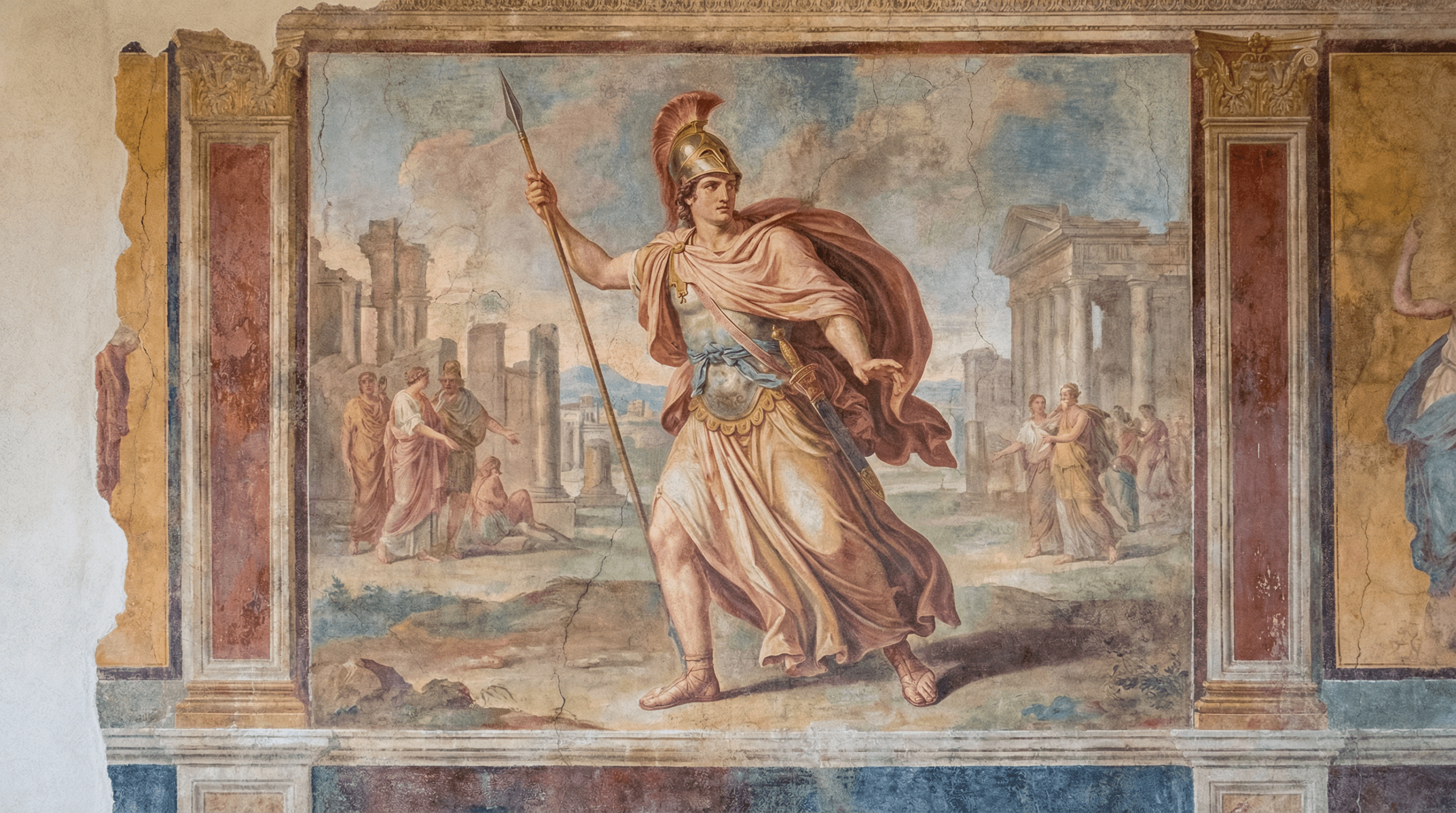
The Wrath and Grief of Achilles
A tale of destiny, friendship, love, and the terrible price of glory in the shadow of Troy’s walls
The Making of a Hero
Destiny marked Achilles before he drew his first breath. Born of the sea nymph Thetis and the mortal king Peleus, he entered the world suspended between two realms—neither fully divine nor wholly human. His mother, knowing the terrible fate that awaited her son, tried desperately to cheat death itself. Some whispered she had dipped him into the river Styx, holding him by the heel as the sacred waters made his flesh impervious to harm. Others claimed she anointed him with ambrosia, the nectar that sustained the gods.
Whatever the truth, young Achilles grew with an otherworldly grace. His hair gleamed like spun bronze in the sunlight, and even as a boy, he moved with the fluid precision of a trained warrior. His education fell to Chiron, the wise centaur who dwelt in the shadowed forests of Mount Pelion. Under Chiron’s tutelage, Achilles learned to track deer through morning mist, to pluck melodies from a lyre that could make grown men weep, and to discern which herbs could heal wounds and which could kill.
But all the knowledge in the world could not compare to the one gift that truly shaped him: the friendship of Patroclus.
Patroclus arrived at Peleus’s court in shame, exiled from his homeland after accidentally killing another boy in a moment of rage. Where others saw a murderer’s son with blood on his hands, Achilles saw only a lonely boy who needed a friend. They became inseparable—training together, eating together, sharing secrets beneath star-scattered skies. Patroclus lacked divine blood and legendary prophecies, but he possessed something Achilles desperately needed: the ability to see beyond the demigod’s destined greatness and recognize the uncertain young man beneath.
Years passed, and the boys became men. The bond between them deepened into something that transcended mere friendship—a love so profound that neither could imagine a world without the other.
The Call to War
Then Helen vanished.
The most beautiful woman in Greece, wife to King Menelaus, had fled to Troy with Paris, a Trojan prince whose pretty face masked his foolish heart. The insult could not stand. Kings and warriors from across Greece assembled, their pride wounded and their honor demanding satisfaction. The greatest army the world had ever seen began to take shape—1,186 ships that would blacken the seas with their passage.
On Mount Olympus, the gods watched and chose sides. Some favored the Greeks, remembering old slights from Trojan kings. Others championed Troy, drawn by the beauty of its walls and the piety of its people. They placed wagers on mortal lives as if they were dice in a game, their arguments echoing across the heavens.
Achilles stood at the water’s edge, watching the fleet assemble. His spear, forged from ash torn from Mount Pelion’s peak, rested against his shoulder. Beside him grazed his immortal horses, Xanthus and Balius—gifts from his mother, born from the very west wind itself. The animals pawed the ground restlessly, sensing the violence to come.
“You don’t have to go,” Patroclus said quietly, though they both knew it was a lie.
Achilles turned to him, and for a moment, his divine confidence faltered. His mother had told him the prophecy years ago: if he sailed to Troy, he would win eternal glory but die young. If he stayed home, he would live a long, peaceful life but be forgotten.
“I do,” Achilles replied simply. “This is my fate.”
“Then I come with you.”
“You have no fate binding you to this war.”
Patroclus smiled, sad and certain. “My fate is bound to yours. That’s enough.”
They sailed together, and Troy’s high walls grew on the horizon like a dark promise.
The Warrior Unleashed
The war began with thunder.
Trojan defenders poured from their gates led by Prince Hector, King Priam’s eldest son—a warrior whose skill and honor were legendary even among the Greeks. He stood taller than most men, his armor gleaming like captured sunlight, his sword an extension of his own arm.
But even Hector paled before Achilles.
The demigod fought like a force of nature given human shape. His spear found throats and hearts with impossible precision. Men fell before him like wheat before the scythe, and the rivers ran red with Trojan blood. He seemed to be everywhere at once—a golden blur of death and fury. Soldiers on both sides swore they saw the gods themselves fighting at his side.
For nine long years, the war ground on. The beaches became graveyards, the camps filled with the groans of the dying. Young men who had sailed from Greece as boys would never return home as men. The glory both sides sought turned to ash in their mouths, yet neither would surrender.
But the greatest threat to the Greeks came not from Trojan swords, but from Greek pride.
The Seeds of Destruction
Achilles had claimed a woman named Briseis during one of his raids—not merely as a captive, but as a prize that represented his honor and status. She was intelligent and brave, and though she had been his enemy, she treated his men’s wounds with gentle hands.
King Agamemnon, commander of all Greek forces, watched Achilles’s growing legend with poisonous envy. His own achievements paled beside the demigod’s, and his authority felt diminished by Achilles’s independent nature. When Agamemnon was forced to return his own captive to appease the gods, he seized Briseis from Achilles’s tent in compensation.
The insult was calculated and devastating.
Achilles stood motionless as Agamemnon’s men led Briseis away, his knuckles white around his spear. For a moment, those nearby swore his eyes blazed with an inhuman light—and they remembered his mother was a goddess, and that divine blood coursed through his veins.
“Fight your own war,” Achilles said, his voice soft and more terrifying than any shout. “I am done.”
He withdrew to his tent, and it was as if the sun had abandoned the Greeks.
The Weight of Absence
Without Achilles, the Greeks crumbled.
Hector led sortie after sortie, pushing the invaders back toward their ships. Greek soldiers died by the dozens, then by the hundreds. Their funeral pyres lit the night sky, and the wailing of the grieving echoed across the camp.
Patroclus moved through the carnage like a man trapped in a nightmare. He bound wounds that would surely kill, held the hands of boys calling for mothers they would never see again. And through it all, Achilles remained in his tent, his rage like a stone wall between him and the dying army.
“You must fight,” Patroclus begged him one night, his hands still stained with Greek blood.
“Let Agamemnon fight. Let him know what his pride has cost.”
“Men are dying!”
“Men are always dying. That’s what men do.”
Patroclus stared at his companion, seeing a stranger. “When did you become so cold?”
Achilles looked away, and for just a moment, his mask cracked. “When I realized that gods and kings see us all as pieces on a board. Perhaps it’s better to stop playing their games.”
But the next day brought new horror.
The Fatal Masquerade
The Trojans breached the Greek fortifications, fighting among the very ships that had brought the invasion. Soon they would burn the fleet, trapping the Greeks in a foreign land with no hope of escape.
Patroclus could bear it no longer.
“Lend me your armor,” he demanded, bursting into Achilles’s tent. “Just for one battle. The Trojans fear you—they’ll retreat at the mere sight of your crest.”
“No.”
“Men are dying while you nurse your wounded pride!”
The words hung between them like a drawn blade. Achilles rose slowly, and for a heartbeat, Patroclus thought he might strike him. Instead, Achilles’s shoulders sagged.
“Take the armor,” he said quietly. “But Patroclus—promise me. Drive them from our ships, but do not pursue them to Troy’s gates. Apollo protects those walls, and he has no love for Greeks.”
Patroclus embraced him fiercely. “I’ll return before sundown. I promise.”
Achilles helped him into the armor—bronze plates that had turned aside a hundred spears, a helmet with its distinctive horsehair crest that struck terror into Trojan hearts. When Patroclus lifted Achilles’s great spear, it felt like holding lightning itself.
“Come back to me,” Achilles whispered, and for the first time in nine years, Patroclus heard fear in his voice.
The Fall
The transformation was instantaneous.
When Patroclus emerged from Achilles’s tent, the Greek soldiers erupted in cheers. Their champion had returned! With renewed courage, they surged forward, and Patroclus led them like the hero he had always known he could be.
The Trojans scattered before him. He fought with a skill that surprised even himself—Achilles’s armor seemed to lend him strength, to guide his movements. For the first time, Patroclus understood what it felt like to be Achilles, to be invincible and terrible and free.
The Greeks drove the Trojans back, step by bloody step. The ships were saved. Victory was at hand.
But Patroclus could not stop.
The intoxication of battle sang in his blood. Troy’s walls rose before him, close enough to touch. So close. He could end this war today. He could become more than just Achilles’s companion—he could become a legend in his own right.
Apollo watched from Troy’s highest tower, his divine eyes narrowing.
Patroclus charged the gates three times. Three times, Apollo’s invisible hand thrust him back. On the fourth attempt, the god descended in terrible glory, his form blazing with celestial light.
“MORTAL,” Apollo’s voice shook the earth. “KNOW YOUR PLACE.”
The god struck Patroclus with the force of an earthquake. The helmet flew from his head. The breastplate unlocked and clattered to the ground. Achilles’s great spear shattered in his hands. Patroclus stood suddenly vulnerable, no longer a demigod in borrowed armor but simply a mortal man who had flown too close to the sun.
Hector saw his chance.
The Trojan prince drove his spear through Patroclus’s chest with grim efficiency. As Patroclus fell, his eyes found the walls of Troy above him—so beautiful, so close, so utterly beyond his reach.
With his last breath, he whispered: “Achilles.”
The Wrath
When they brought Patroclus’s body back to camp, Achilles was tending to his horses.
He knew before he saw the corpse. Perhaps the gods told him, or perhaps some part of his soul simply knew when its other half had been torn away. He walked out slowly, and when he saw Patroclus’s still form, something inside him shattered.
The sound that emerged from Achilles transcended human grief. It was the howl of a wounded animal, the scream of a god, the death rattle of the world itself. He fell to his knees beside the body, cradling Patroclus’s bloodied head in his lap.
All the anger at Agamemnon, all the pride that had kept him from battle—it evaporated like morning mist. None of it mattered. Nothing mattered except the growing cold beneath his fingertips, the absence of breath, the terrible stillness.
His mother rose from the sea that night, her divine presence shimmering in the darkness. She held her son while he wept, but even she could not comfort him. Thetis knew that her son’s fate had finally caught up with him—grief had forged chains stronger than any prophecy.
“I will kill them all,” Achilles said, his voice empty and certain. “Every Trojan who stands. Every man who thought he could take him from me. I will paint Troy red with their blood.”
“My son,” Thetis whispered. “If you do this, your own death follows swiftly.”
Achilles looked up at her with eyes that held no light. “Good. What is life without him?”
She brought him new armor then, forged by Hephaestus himself in the gods’ workshops—armor that gleamed like captured starlight, inlaid with scenes of war and peace, life and death. It was the most beautiful thing ever crafted by divine hands, and Achilles looked upon it with complete indifference.
He had only one purpose now.
The Reckoning
Achilles returned to battle like death made flesh.
He tore through Trojan ranks with inhuman fury, his spear never missing, his sword never tiring. Men fell before him in heaps. He fought with no regard for his own safety, seeking not glory but annihilation—of his enemies, of himself, of the entire world that had dared to continue existing after Patroclus’s death.
The river Scamander ran so thick with bodies that it overflowed its banks. The river god himself rose up in protest, but even divine intervention could not stop Achilles’s rampage. He was grief weaponized, loss given form and purpose.
Trojans fled behind their walls. The great gates slammed shut. But one man remained outside.
Hector stood alone before Troy’s walls, still wearing Achilles’s old armor—the armor that had failed to protect Patroclus. He had sent his wife and infant son to safety, knowing he would never see them again. Honor demanded he face the monster he had helped create.
Achilles approached slowly, his footsteps measured, his eyes locked on Hector. The Trojan prince felt his courage waver—this was not the Achilles of nine years prior, fighting for glory and kleos. This was something else entirely.
“Achilles,” Hector called out, his voice steady despite his fear. “Let us make a pact. If I fall, treat my body with respect. If you fall, I shall do the same.”
Achilles smiled, and it was the most terrible thing Hector had ever seen.
“Lions do not make pacts with men,” Achilles said softly. “And I will grant you no dignity in death, Hector. You wore his armor. You stood over his body. You do not deserve dignity.”
They fought beneath Troy’s walls as both armies watched in silence.
It was no contest. Achilles knew every weakness in his old armor, had trained in it for years. When Hector thrust his spear, Achilles swayed aside. When Hector raised his sword, Achilles was already inside his guard. His spear found the gap between breastplate and helmet, and Hector fell.
But Achilles’s fury was not satisfied.
The Desecration
He stripped Hector’s body and bound it to his chariot. Then, as the Trojans watched in horror from their walls, he dragged the corpse through the dust—around the city, around the Greek camp, again and again until Hector’s noble face was reduced to pulp and gore.
The gods themselves turned away in disgust. To deny burial was a sin that stained the soul, but Achilles no longer cared about his soul. Every night, he dragged Hector’s corpse around Patroclus’s pyre, as if violence could somehow fill the void inside him.
It couldn’t.
Patroclus came to him in dreams, his form translucent and sad. “Why do you keep me waiting? Bury me so I can cross into the underworld. Let me rest.”
“Not yet,” Achilles whispered. “Not until—”
“Until what? Until you’ve killed enough men? Until your grief is satisfied?” Patroclus’s shade reached out but could not touch him. “Nothing will bring me back. But we can be together again. Bury me, and when you fall, let our ashes mingle. Let us be united in death as we were in life.”
Achilles tried to embrace him, but his arms closed on empty air. The ghost faded, and Achilles was alone again, surrounded by death and fire and his own endless rage.
The King’s Plea
King Priam was an old man who had lived too long and seen too much. He had fifty sons once. Now Hector, the greatest of them all, lay somewhere in the Greek camp being desecrated by a madman.
Against all advice, Priam left Troy in the dead of night. He brought a wagon laden with treasures—gold and silver, fine cloths, ancient weapons. He had buried many sons, but he would not let Hector rot unburied. Even if it cost him his own life.
The Greek guards, struck by divine intervention or simple pity, let the old king pass.
Priam found Achilles in his tent, staring at nothing. When the old king entered and knelt, Achilles looked up in surprise.
“I come to beg,” Priam said simply, “for my son’s body.”
Achilles’s hand moved to his sword.
“I kiss the hands that killed him,” Priam continued, pressing his lips to Achilles’s bloodstained fingers. “I do what no father should ever have to do. But I am a father still, and I would bury my child.”
Something in Achilles’s chest cracked. He looked at this old man, broken by grief, humbling himself before his son’s killer—and he saw his own father, who would soon kneel beside his own pyre. He saw all the fathers throughout Greece and Troy, all the mothers, all the lovers left behind by this pointless war.
“He died well,” Achilles said quietly. “He knew I would kill him, but he stood his ground. That takes courage.”
“He spoke of you often,” Priam replied. “He called you the greatest warrior he had ever seen. Even as enemies, he respected you.”
They wept together then—a murderer and a father, united in loss. They shared a meal in the depths of night, two men who had lost everything that mattered, finding brief companionship in shared suffering.
“I will give you twelve days to honor him,” Achilles said. “I swear no Greek will attack Troy while you mourn.”
“Thank you,” Priam whispered, and for the first time in weeks, Achilles felt something other than rage.
He prepared Hector’s body himself, washing away the dust, closing the wounds. “Forgive me,” he whispered to Patroclus’s spirit. “I do not forget you. But this… this has to end.”
The Final Arrow
Achilles buried Patroclus with honors fit for a king. The pyre burned for days, and when it cooled, he gathered the ashes into a golden urn, saving space for his own remains. He knew they wouldn’t wait long.
He returned to battle with a strange peace. The fury had burned itself out, leaving only tired acceptance. He fought brilliantly as always, cutting down Troy’s greatest warriors. But he was mortal now—not in body, but in spirit. He had surrendered to fate.
Paris watched from Troy’s walls, his bow strung. He was not a great warrior like his brother had been. He was vain and foolish and had started a war for a woman. But he could shoot.
Apollo guided his hand, or perhaps Apollo merely watched. The arrow flew true, striking Achilles in the heel—the one spot his mother’s hand had covered, the only place vulnerable to mortal weapons.
Achilles fell, surprised by how little it hurt. He had survived a thousand battles, killed hundreds of men, defied gods themselves. And he died from an arrow to the ankle, shot by a coward.
As his vision dimmed, he smiled. Patroclus was waiting.
Epilogue
They mingled their ashes as Patroclus had requested, placing them together in the golden urn. Two souls, finally reunited, impossible to separate even in death.
The Greeks eventually won their war through trickery rather than valor, hiding soldiers inside a wooden horse to breach Troy’s impregnable walls. The city burned, and its men were slaughtered, its women enslaved.
But victory tasted like ashes. In their pursuit of glory and honor, both Greeks and Trojans had lost their greatest heroes. Young men who should have grown old surrounded by grandchildren had become bones in foreign soil. Love had been sacrificed on the altar of pride.
The poets would sing of Achilles’s glory for thousands of years, of his terrible rage and his tragic fate. They would debate whether he was hero or monster, whether his love for Patroclus was friendship or something deeper, whether the war was worth its cost.
But perhaps the only truth that mattered was this: Achilles had been given a choice between a long, forgotten life and a short, glorious one. In the end, though, he chose neither glory nor longevity.
He chose love.
And when that love was torn from him, he chose to follow it into darkness—because what is glory without someone to share it with? What is life without the person who makes you feel alive?
Their story ended in fire and blood and grief. But it began in friendship, grew into devotion, and transformed into a love so profound that death itself could not sever it. The urn sat in Patroclus’s tomb, two souls merged forever, their story hardening into legend—a testament to the truth that the greatest warriors are not those who cannot be defeated, but those who love so deeply they are willing to risk everything.
Even themselves.
Explore More Epic Tales of Greek Mythology
Discover the stories that have captivated humanity for millennia.
From the labors of Heracles to the cunning of Odysseus, from the tragic love of Orpheus and Eurydice to the hubris of Icarus—immerse yourself in the timeless legends that shaped Western civilization.
Coming Next: The Odyssey – A Hero’s Journey Home